Análisis del ciclo de vida: comparación entre dos puentes postesados óptimos de sección en cajón

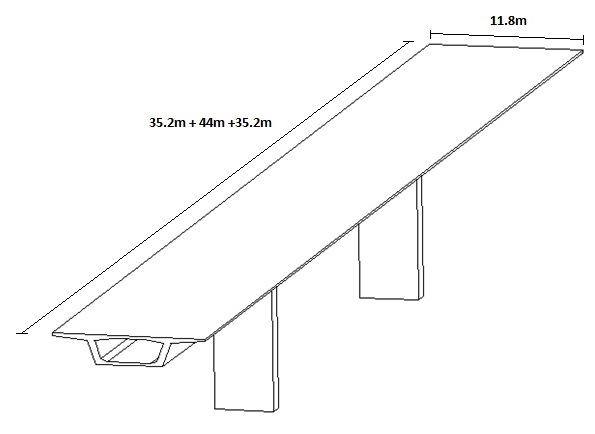
Acaban de publicarnos un artículo en la revista del JCR (Q2) Sustainability que compara dos puentes postesados óptimos de sección en cajón atendiendo a su ciclo de vida. Creemos que la metodología empleada puede ser de interés para casos de estructuras de hormigón similares a las presentadas. El artículo forma parte del proyecto de investigación BRIDLIFE «Puentes pretensados de alta eficiencia social y medioambiental bajo presupuestos restrictivos«.

Os paso a continuación el resumen y el artículo propiamente dicho, pues está publicado en abierto.


Abstract:

The goal of sustainability involves a consensus among economic, environmental and social factors. Due to climate change, environmental concerns have increased in society. The construction sector is among the most active high environmental impact sectors. This paper proposes new features to consider a more detailed life-cycle assessment (LCA) of reinforced or pre-stressed concrete structures. Besides, this study carries out a comparison between two optimal post-tensioned concrete box-girder road bridges with different maintenance scenarios. ReCiPe method is used to carry out the life-cycle assessment. The midpoint approach shows a complete environmental profile with 18 impact categories. In practice, all the impact categories make their highest contribution in the manufacturing and use and maintenance stages. Afterwards, these two stages are analyzed to identify the process which makes the greatest contribution. In addition, the contribution of CO2fixation is taken into account, reducing the environmental impact in the use and maintenance and end of life stages. The endpoint approach shows more interpretable results, enabling an easier comparison between different stages and solutions. The results show the importance of considering the whole life-cycle, since a better design reduces the global environmental impact despite a higher environmental impact in the manufacturing stage.

Keywords:

sustainabilityenvironmental impactlife-cycle assessmentconstruction LCAbridge LCAReCiPe;sustainable construction

Reference:

PENADÉS-PLÀ, V.; MARTÍ, J.V.; GARCÍA-SEGURA, T.;  YEPES, V. (2017). Life-cycle assessment: A comparison between two optimal post-tensioned concrete box-girder road bridges. Sustainability, 9(10):1864. doi:10.3390/su9101864 (link)

Pincha aquí para descargar

La construcción romana, el hormigón y otras cosas en Radio Nacional

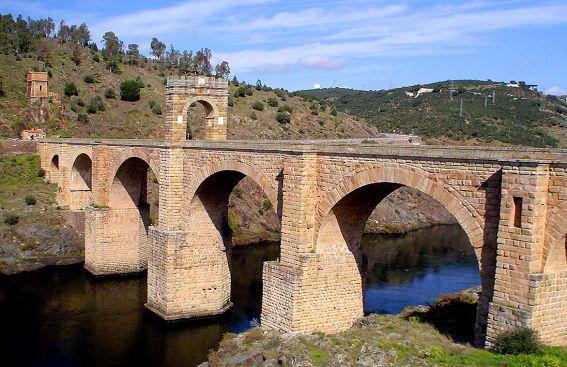
Puente de Alcántara, puente romano en arco construido entre 104 y 106, que cruza el río Tajo en la localidad cacereña de Alcántara.

Resulta gratificante tener la oportunidad de conversar tranquilamente en un medio de comunicación como es Radio Nacional de España sobre ciencia, tecnología e ingeniería. El otro día me entrevistaron en el programa «24 horas«, presentado por Miguel Ángel Domínguez sobre la construcción romana, el hormigón y otros aspectos relacionados con la ingeniería civil y la inteligencia artificial. Se trata de un programa que dedica un espacio los miércoles a la tertulia científica y es, para la ingeniería, una oportunidad para acercar la técnica al gran público, facilitando la labor tan importante de divulgación científica.


Hablamos sobre las razones por las cuales las construcciones romanas han llegado hasta nuestros días, de la calidad de los hormigones romanos, del impacto medioambiental de la fabricación del cemento Portland, de la tecnología actual de la construcción y de la aplicación de la inteligencia artificial en el diseño automático y óptimo de puentes. Aunque la entrevista se quedó muy corta y nos dejamos en el tintero muchas cosas, os paso el post para que lo escuchéis en cualquier momento. También tenéis otras entrevistas anteriores relacionadas con el puente Hong Kong-Zhuhai-Macao, o con el Golden Gate. Espero que os sean de interés.


Valoración de la contribución de una infraestructura a la sostenibilidad social bajo condiciones de incertidumbre

Nos acaban de publicar en la revista de Elsevier del primer cuartil, Environmental Impact Assessment Review, un artículo donde se valora la contribución de una infraestructura a la sostenibilidad social bajo condiciones de incertidumbre. Este artículo forma parte de nuestra línea de investigación BRIDLIFE en la que se pretenden optimizar estructuras atendiendo no solo a su coste, sino al impacto ambiental y social que generan a lo largo de su ciclo de vida.


Abstract:

Assessing the viability of a public infrastructure includes economic, technical and environmental aspects; however, on many occasions, the social aspects are not always adequately considered. This article proposes a procedure to estimate the social sustainability of infrastructure projects under conditions of uncertainty, based on a multicriteria deterministic method. The variability of the method inputs is contributed by the decision-makers. Uncertain inputs are treated through uniform and beta PERT distributions. The Monte Carlo method is used to propagate uncertainty in the method. A road infrastructure improvement case study in El Salvador illustrates this treatment. The main results determine the variability of the short and long-term social improvement indices by infrastructure and the probability of the position in prioritizing the alternatives. The proposed mechanism improves the reliability of the decision-making early in infrastructure projects, taking their social contribution into account. The results can complement environmental and economic sustainability assessments.

Keywords:

  • Infrastructure;
  • Multicriteria decision-making;
  • Uncertainty;
  • Social sustainability


Reference:

SIERRA, L.A.; YEPES, V.; PELLICER, E. (2017). Assessing the social sustainability contribution of an infrastructure project under conditions of uncertainty. Environmental Impact Assessment Review,67:61-72.


Optimización heurística de ménsulas cortas mediante elementos finitos con fisuración distribuida

A continuación os dejo un artículo donde se aplica la optimización heurística mediante recocido simulado de ménsulas cortas de hormigón armado, usando para ello elementos finitos con fisuración distribuida.

También puedes encontrar el artículo en acceso abierto en: https://www.witpress.com/elibrary/wit-transactions-on-the-built-environment/125/23501


Referencia:

ROJAS, G.; ROJAS, P.; GONZÁLEZ-VIDOSA, F.; YEPES, V. (2012). Heuristic optimization of short corbels by smeared cracking finite element analysis. International Conference on Computer Aided Optimum Design in Engineering, 20-22 june. Computer Aided Optimum Design in Engineering XII. Vol. 125, pp. 71-82. Edited By: S. HERNANDEZ, University of A Coruña, Spain, C.A. BREBBIA, Wessex Institute of Technology, UK and W.P. DE WILDE, Vrije Universiteit Brussel, Belgium. DOI: 10.2495/OP120071  ISSN: 1743-3509 (on line).


Pincha aquí para descargar


¿Es fácil optimizar estructuras de hormigón?

Es más, ¿es posible que un ordenador diseñe de forma automática estructuras óptimas sin darle ninguna pista ni información previa? Estoy convencido de que a la vuelta de un par de años, todos los programas comerciales tendrán paquetes de optimización estructural que permitirán reducciones de coste del 5 al 15% respecto a los programas actuales. Ya os adelanto que esta nueva tecnología va a traer consigo nuevas patologías en las estructuras de hormigón, que, con la optimización, se parecen más a las estructuras metálicas. Con el tiempo habrá que introducir capítulos o restricciones en las futuras versiones de la EHE o de los Eurocódigos. En este post continuamos comentando aspectos relacionados con la modelización matemática, la optimización combinatoria, las metaheurísticas y los algoritmos.

Toda esta aventura la empezamos en el año 2002, con el primer curso de doctorado sobre optimización heurística en la ingeniería civil, que luego hemos ido ampliando y mejorando en el actual Máster Oficial en Ingeniería del Hormigón. Ya tenemos varias tesis doctorales y artículos científicos al respecto para quienes de vosotros estén curiosos o interesados en el tema. Para aquellos que queráis ver algunas aplicaciones concretas, os recomiendo el siguiente capítulo del libro que escribimos sobre la optimización de distintas estructuras mediante un algoritmo tan simple como la cristalización simulada. Para quienes tengan más curiosidad, os dejo algunas publicaciones de nuestro grupo de investigación en el apartado de referencias.

Os paso, para abrir la boca, una forma sencilla de optimizar a través de este Polimedia. Espero que os guste.

Referencias:

  • MOLINA-MORENO, F.; MARTÍ, J.V.; YEPES, V. (2017). Carbon embodied optimization for buttressed earth-retaining walls: implications for low-carbon conceptual designs. Journal of Cleaner Production, 164:872-884. https://authors.elsevier.com/a/1VLOP3QCo9NDzg 
  • GARCÍA-SEGURA, T.; YEPES, V.; FRANGOPOL, D.M.; YANG, D.Y. (2017). Lifetime Reliability-Based Optimization of Post-Tensioned Box-Girder Bridges. Engineering Structures, 145:381-391. DOI:10.1016/j.engstruct.2017.05.013 OPEN ACCESS
  • GARCÍA-SEGURA, T.; YEPES, V.; FRANGOPOL, D.M. (2017). Multi-Objective Design of Post-Tensioned Concrete Road Bridges Using Artificial Neural Networks. Structural and Multidisciplinary Optimization, 56(1):139-150. doi: 10.1007/s00158-017-1653-0
  • YEPES, V.; MARTÍ, J.V.; GARCÍA-SEGURA, T.; GONZÁLEZ-VIDOSA, F. (2017). Heuristics in optimal detailed design of precast road bridges. Archives of Civil and Mechanical Engineering, 17(4):738-749. DOI: 10.1016/j.acme.2017.02.006
  • MOLINA-MORENO, F.; GARCÍA-SEGURA; MARTÍ, J.V.; YEPES, V. (2017). Optimization of Buttressed Earth-Retaining Walls using Hybrid Harmony Search Algorithms. Engineering Structures, 134:205-216. DOI: 10.1016/j.engstruct.2016.12.042
  • GARCÍA-SEGURA, T.; YEPES, V. (2016). Multiobjective optimization of post-tensioned concrete box-girder road bridges considering cost, CO2 emissions, and safety. Engineering Structures, 125:325-336. DOI: 10.1016/j.engstruct.2016.07.012.
  • MARTÍ, J.V.; GARCÍA-SEGURA, T.; YEPES, V. (2016). Structural design of precast-prestressed concrete U-beam road bridges based on embodied energy. Journal of Cleaner Production, 120:231-240. DOI: 10.1016/j.jclepro.2016.02.024
  • GARCÍA-SEGURA, T.; YEPES, V.; ALCALÁ, J.; PÉREZ-LÓPEZ, E. (2015). Hybrid harmony search for sustainable design of post-tensioned concrete box-girder pedestrian bridges. Engineering Structures, 92:112-122. DOI: 10.1016/j.engstruct.2015.03.015 (link)
  • LUZ, A.; YEPES, V.; GONZÁLEZ-VIDOSA, F.; MARTÍ, J.V. (2015). Diseño de estribos abiertos en puentes de carretera obtenidos mediante optimización híbrida de escalada estocástica. Informes de la Construcción, 67(540), e114. DOI: 10.3989/ic.14.089
  • MARTÍ, J.V.; YEPES, V.; GONZÁLEZ-VIDOSA, F. (2015). Memetic algorithm approach to designing of precast-prestressed concrete road bridges with steel fiber-reinforcement. Journal of Structural Engineering ASCE, 141(2): 04014114. DOI:10.1061/(ASCE)ST.1943-541X.0001058 (descargar versión autor)
  • YEPES, V.; GARCÍA-SEGURA, T.; MORENO-JIMÉNEZ, J.M. (2015). A cognitive approach for the multi-objective optimization of RC structural problems. Archives of Civil and Mechanical Engineering, 15(4):1024-1036. doi:10.1016/j.acme.2015.05.001
  • YEPES, V.; MARTÍ, J.V.; GARCÍA-SEGURA, T. (2015). Cost and CO2 emission optimization of precast-prestressed concrete U-beam road bridges by a hybrid glowworm swarm algorithm. Automation in Construction, 49:123-134. DOI: 10.1016/j.autcon.2014.10.013 (link)
  • GARCÍA-SEGURA, T.; YEPES, V.; MARTÍ, J.V.; ALCALÁ, J. (2014). Optimization of concrete I-beams using a new hybrid glowworm swarm algorithm. Latin American Journal of Solids and Structures,  11(7):1190 – 1205. ISSN: 1679-7817. (link)
  • MARTÍ, J.V.; YEPES, V.; GONZÁLEZ-VIDOSA, F.; LUZ, A. (2013). Diseño automático de tableros óptimos de puentes de carretera de vigas artesa prefabricadas mediante algoritmos meméticos híbridos. Revista Internacional de Métodos Numéricos para Cálculo y Diseño en Ingeniería, DOI: http://dx.doi.org/10.1016/j.rimni.2013.04.010.
  • TORRES-MACHÍ, C.; YEPES, V.; ALCALA, J.; PELLICER, E. (2013). Optimization of high-performance concrete structures by variable neighborhood search. International Journal of Civil Engineering, 11(2):90-99 . ISSN: 1735-0522. (link)
  • MARTÍNEZ-MARTÍN, F.; GONZÁLEZ-VIDOSA, F.; HOSPITALER, A.; YEPES, V. (2013). A parametric study of optimum tall piers for railway bridge viaducts. Structural Engineering and Mechanics45(6): 723-740. (link)
  • MARTINEZ-MARTIN, F.J.; GONZALEZ-VIDOSA, F.; HOSPITALER, A.; YEPES, V. (2012). Multi-objective optimization design of bridge piers with hybrid heuristic algorithms. Journal of Zhejiang University-SCIENCE A (Applied Physics & Engineering, 13(6):420-432. DOI: 10.1631/jzus.A1100304. ISSN 1673-565X (Print); ISSN 1862-1775 (Online).  (link)
  • MARTÍ, J.V.; GONZÁLEZ-VIDOSA, F.; YEPES, V.; ALCALÁ, J. (2013). Design of prestressed concrete precast road bridges with hybrid simulated annealing. Engineering Structures48:342-352. DOI:10.1016/j.engstruct.2012.09.014. ISSN: 0141-0296.(link)
  • YEPES, V.; GONZÁLEZ-VIDOSA, F.; ALCALÁ, J.; VILLALBA, P. (2012). CO2-Optimization Design of Reinforced Concrete Retaining Walls based on a VNS-Threshold Acceptance Strategy. Journal of Computing in Civil Engineering ASCE, 26 (3):378-386. DOI: 10.1061/(ASCE)CP.1943-5487.0000140. ISNN: 0887-3801. (link)
  • CARBONELL, A.; YEPES, V.; GONZÁLEZ-VIDOSA, F. (2011). Búsqueda exhaustiva por entornos aplicada al diseño económico de bóvedas de hormigón armado. Revista Internacional de Métodos Numéricos para Cálculo y Diseño en Ingeniería, 27(3):227-235.  (link) [Global best local search applied to the economic design of reinforced concrete vauls]
  • CARBONELL, A.; GONZÁLEZ-VIDOSA, F.; YEPES, V. (2011). Heuristic optimization of reinforced concrete road vault underpasses. Advances in Engineering Software, 42(4): 151-159. ISSN: 0965-9978.  (link)
  • MARTÍNEZ, F.J.; GONZÁLEZ-VIDOSA, F.; HOSPITALER, A. (2011). Estudio paramétrico de pilas para viaductos de carretera. Revista Internacional de Métodos Numéricos para Cálculo y Diseño en Ingeniería, 27(3):236-250. (link)
  • MARTÍNEZ, F.J.; GONZÁLEZ-VIDOSA, F.; HOSPITALER, A.; ALCALÁ, J. (2011). Design of tall bridge piers by ant colony optimization. Engineering Structures, 33:2320-2329.
  • PEREA, C.; YEPES, V.; ALCALÁ, J.; HOSPITALER, A.; GONZÁLEZ-VIDOSA, F. (2010). A parametric study of optimum road frame bridges by threshold acceptance. Indian Journal of Engineering & Materials Sciences, 17(6):427-437. ISSN: 0971-4588.  (link)
  • PAYÁ-ZAFORTEZA, I.; YEPES, V.; GONZÁLEZ-VIDOSA, F.; HOSPITALER, A. (2010). On the Weibull cost estimation of building frames designed by simulated annealing. Meccanica, 45(5): 693-704. DOI 10.1007/s11012-010-9285-0. ISSN: 0025-6455.  (link)
  • MARTÍ, J.V.; GONZÁLEZ-VIDOSA, F. (2010). Design of prestressed concrete precast pedestrian bridges by heuristic optimization. Advances in Engineering Software, 41(7-8): 916-922. http://dx.doi.org/10.1016/j.advengsoft.2010.05.003
  • MARTÍNEZ, F.J.; GONZÁLEZ-VIDOSA, F.; HOSPITALER, A.; YEPES, V. (2010). Heuristic Optimization of RC Bridge Piers with Rectangular Hollow Sections. Computers & Structures, 88: 375-386. ISSN: 0045-7949.  (link)
  • PAYÁ, I.; YEPES, V.; HOSPITALER, A.; GONZÁLEZ-VIDOSA, F. (2009). CO2-Efficient Design of Reinforced Concrete Building Frames. Engineering Structures, 31: 1501-1508. ISSN: 0141-0296. (link)
  • YEPES, V.; ALCALÁ, J.; PEREA, C.; GONZÁLEZ-VIDOSA, F. (2008). A Parametric Study of Optimum Earth Retaining Walls by Simulated Annealing. Engineering Structures, 30(3): 821-830. ISSN: 0141-0296.  (link)
  • PEREA, C.; ALCALÁ, J.; YEPES, V.; GONZÁLEZ-VIDOSA, F.; HOSPITALER, A. (2008). Design of Reinforced Concrete Bridge Frames by Heuristic Optimization. Advances in Engineering Software, 39(8): 676-688. ISSN: 0965-9978.  (link)
  • PAYÁ, I.; YEPES, V.; GONZÁLEZ-VIDOSA, F.; HOSPITALER, A. (2008). Multiobjective Optimization of Reinforced Concrete Building Frames by Simulated Annealing. Computer-Aided Civil and Infrastructure Engineering, 23(8): 596-610. ISSN: 1093-9687.  (link)
  • PAYÁ, I.; YEPES, V.; CLEMENTE, J.J.; GONZÁLEZ-VIDOSA, F. (2006). Optimización heurística de pórticos de edificación de hormigón armado. Revista Internacional de Métodos Numéricos para Cálculo y Diseño en Ingeniería, 22(3): 241-259. [Heuristic optimization of reinforced concrete building frames]. (link)

Sustainable assessment of retaining walls through an active learning method considering multiple stakeholders

ABSTRACT: The sustainability approach has changed the modern society. Currently, the sustainability takes into consideration, not only the economic and environmental facets, but also the social facet. Taking into account the three facets of sustainability, this paper shows the application of a method of active learning to assess the sustainability of three real retaining walls. A group of 29 students of the Master of Science in Planning and Management in Civil Engineering at the Universitat Politècnica de València has experienced this assessment. The method followed was proposed by academics of the School of Civil Engineering of the Universitat Politècnica de València (Spain) and Universidad de La Frontera (Chile). An approach multi-criteria and a clusters analysis are part of method, which allows developing a participative process with different points of view about the sustainability. The outcomes show that of this way students can forecast impacts from of the integration of design, planning and the location context of the infrastructure. Result evidence that personal values of each student influences the election of the optimal alternative. The paper also identifies the need to strengthen the conceptualization of social criteria in the students training.

KEYWORDS: Infrastructure, Education, Cluster analysis, Analytic hierarchy process, Civil engineering, Sustainability

REFERENCE:

SIERRA-VARELA, L.; YEPES, V.; PELLICER, E. (2017). Sustainable assessment of retaining walls through an active learning method considering multiple stakeholders. Proceedings of the Ninth International Structural Engineering and Construction Conference, Valencia, Spain, July 24-July 29.  doi: 10.14455/ISEC.res.2017.51

Pincha aquí para descargar


Diseño óptimo sostenible de muros de contrafuertes

Nos acaban de publicar en la revista de Elsevier del primer decil, Journal of Cleaner Production, un artículo en el que se estudia el diseño de muros de contrafuertes optimizados para reducir sus emisiones de CO2. Este artículo forma parte de nuestra línea de investigación BRIDLIFE, en la que se pretende optimizar las estructuras atendiendo no solo a su coste, sino también al impacto ambiental que generan a lo largo de su ciclo de vida.

Abstract:

This paper shows the differences in the design of a reinforced concrete structure when two objectives are considered: minimizing economic cost and CO2 emissions. Both objectives depend on the amount of two high-carbon-intensive materials: cement in the concrete and steel; therefore, these objectives are related. As the balance between steel and cement per m3 of concrete depends on several factors, such as the type of structure, this study focuses on buttressed earth-retaining walls. Another factor that determines the balance between steel and concrete is the wall’s height. Thus, the methodology employs a parametric study of optimal designs for buttressed earth-retaining walls, with the wall height as one parameter. One objective is to show the variation in cost when CO2 is minimized while respecting economic constraints. The findings show that wall elements under bending-compressive strains (i.e., the buttressed retaining wall stem) behave differently depending on the target function. On the one hand, the study reveals an upward trend in steel per unit volume of concrete in emission-optimized earth-retaining buttressed walls compared to cost-optimized ones. On the other hand, it is observed that, unlike cost-optimized walls, emission-optimized walls use a higher concrete class than the minimum available. These findings indicate that emission-optimized walls penalize not only concrete volume but also cement content, to the extent that a higher concrete class outperforms in terms of reduced emissions. Additionally, the paper outlines how and to what extent the design of this typology varies across the two analyzed objectives in terms of geometry and material quantity. Some relevant differences influencing the geometry of design strategies are found.

Keywords:

Carbon emission; CO2; earth-retaining wall; reinforced concrete; Harmony search; Threshold accepting

Reference:

MOLINA-MORENO, F.; MARTÍ, J.V.; YEPES, V. (2017). Carbon embodied optimization for buttressed earth-retaining walls: implications for low-carbon conceptual designs. Journal of Cleaner Production, 164:872-884.

Pincha aquí para descargar

Special Issue «Sustainable Construction»

High visibility: indexed by the Science Citation Index Expanded, the Social Sciences Citation Index (Web of Science) and other databases. Impact Factor: 1.343 (2015)

Special Issue «Sustainable Construction»

A special issue of Sustainability (ISSN 2071-1050). This special issue belongs to the section «Sustainable Engineering and Science«.

Deadline for manuscript submissions: 30 November 2017

Special Issue Editors

Guest Editor

Prof. Dr. Víctor Yepes
Concrete Science and Technology Institute (ICITECH), Department of Construction Engineering and Civil Engineering Projects, Universitat Politècnica de València Valencia, Spain
Interests: multi-objective optimization; life-cycle assessment; decision-making; sustainability; concrete structures; CO2 emissions; construction management

Guest Editor

Dr. Tatiana García-Segura
Concrete Science and Technology Institute (ICITECH), Department of Construction Engineering and Civil Engineering Projects, Universitat Politècnica de València Valencia, Spain
Interests: multi-objective optimization; durability; safety; sustainability; post-tensioned bridges; maintenance; blended cement; recycled concrete

Special Issue Information

Dear Colleagues,

This «Sustainable Construction» Special Issue comprises selected papers for Sustainability. Construction is one of the main sectors generating greenhouse gases. This industry consumes large amounts of raw materials, such as stone, timber, water, etc. Additionally, infrastructure should provide service over many years without safety problems. Therefore, their correct design, construction, maintenance and dismantling are essential to reduce economic, environmental and societal consequences. That is why promoting sustainable construction is becoming extremely important nowadays. This Special Issue is seeking papers that explore new ways of reducing the environmental impacts caused by the construction sector, as well promoting social progress and economic growth. These objectives include, but are not limited to:

  • The use of sustainable materials in construction
  • The development of technologies and processes intended to improve sustainability in construction
  • The optimization of designs based on sustainable indicators
  • The reduction of the economic, environmental and social impact caused by production processes
  • The promotion of durable materials that reduce the future maintenance
  • The life-cycle assessment
  • Decision-making processes that integrate economic, social, and environmental aspects

Papers selected for this Special Issue are subject to a rigorous peer-review procedure with the aim of rapid and wide dissemination of research results, developments and applications.

Submission

Manuscripts should be submitted online at www.mdpi.com by registering and logging in to this website. Once you are registered, click here to go to the submission form. Manuscripts can be submitted until the deadline. Papers will be published continuously (as soon as accepted) and will be listed together on the special issue website. Research articles, review articles as well as communications are invited. For planned papers, a title and short abstract (about 100 words) can be sent to the Editorial Office for announcement on this website.

Submitted manuscripts should not have been published previously, nor be under consideration for publication elsewhere (except conference proceedings papers). All manuscripts are refereed through a peer-review process. A guide for authors and other relevant information for submission of manuscripts is available on the Instructions for Authors page. Sustainability is an international peer-reviewed Open Access monthly journal published by MDPI.

Keywords

  • sustainable materials
  • life-cycle assessment
  • sustainable and efficient technologies and processes
  • design optimization
  • durable materials
  • maintenance minimization
  • decision-making

Special Issue on Advanced Optimization Techniques and Their Applications in Civil Engineering

Civil Engineers are involved with the creation, monitoring, and management of infrastructural resources, as well as the e›cient, economic utilization and management of renewable natural resources. Nowadays a rapid growth of computer performance enables and encourages new developments in civil engineering as well as related areas. For instance, the construction industry investigates new designs with minimum cost, minimum CO2 emissions, or embodied energy, among other objectives. Conventional optimization techniques are usually inadequate to nd best designs by taking into account all design variables, objectives, and constraints in the complex civil engineering problems. Applications of optimization techniques are most exciting, challenging, and of truly large scale when it comes to the problems of civil engineering in terms of both quality and quantity. In order to overcome the di›culties, researchers are interested in advanced optimization techniques. In the recent literature, researchers have applied the advanced optimization techniques to dišerent purposes.

The aim of this special issue is to collect the studies using optimization algorithms in civil engineering problems such as structural engineering, construction management, and environmental engineering. Potential topics include but are not limited to the following: Intelligent optimization Swarm and evolutionary optimization techniques Single and multiobjective optimization Predictive modeling and optimization Computational complexity and optimization Continuous or discrete optimization Structural optimization Size, shape, and topology optimization New design optimization applications in civil engineering New and novel approaches and techniques for solving optimization problems in civil engineering New research in any areas closely related to optimization and civil engineering designs Authors can submit their manuscripts through the Manuscript Tracking System at http://mts.hindawi.com/submit/journals/ace/otace/

Pincha aquí para descargar


Algunas conclusiones obtenidas del proyecto BRIDLIFE sobre puentes postesados en cajón

A punto de terminar el proyecto de investigación BRIDLIFE, a continuación se exponen algunas conclusiones de interés fruto de dicho proyecto y de la tesis doctoral y publicaciones de la profesora Tatiana García Segura. Son pequeñas «píldoras» de conocimiento que pueden ser de interés para proyectistas e investigadores relacionados con los puentes, el hormigón, la sostenibilidad y la optimización. Son las siguientes:

  1. A pesar de la reducción de durabilidad por carbonatación y la menor captura de CO2, los cementos con adiciones resultan beneficiosos desde el punto de vista ambiental [1].
  2. Mientras el uso del hormigón reciclado como árido afecta a las propiedades del hormigón y requiere en muchos casos un incremento en el contenido de cemento, la reutilización del hormigón como material granular de relleno permite una completa carbonatación del hormigón que reduce las emisiones de CO2 [1].
  3. Se puede mejorar la seguridad estructural de los puentes en cajón con un pequeño incremento de coste siempre que se escojan las variables adecuadas [2]. Este incremento de coste no es constante para todos los niveles de seguridad. Se pueden establecer diferentes puntos, a partir de los cuales resulta más caro mejorar la seguridad estructural [2].
  4. No se aconseja aumentar el espesor de la losa superior para mejorar la seguridad de los puentes en cajón, ya que ello conlleva un aumento de peso innecesario [2]. Sin embargo, el espesor de las alas en el arranque es un aspecto clave para mejorar la flexión transversal [2].
  5. A pesar de que se ha considerado la inclinación del alma como variable de optimización, su valor óptimo apenas difiere para distintos valores de seguridad.  Esto se debe a que tanto el canto como el ancho de inclinación del alma aumentan en paralelo para mejorar la seguridad estructural [2].
  6. El uso de hormigón de alta resistencia en puentes no muestra ventajas económicas a corto plazo, pues las restricciones de servicio y armadura mínima no permiten reducir el canto y la cantidad de armadura [2]. Sin embargo, el hormigón de alta resistencia retrasa el inicio de la corrosión [3] y mejora el rendimiento estructural una vez se ha iniciado la corrosión [4]. Si se diseñan estructuras con hormigones de alta resistencia se consiguen mejores resultados durante el ciclo de vida que con diseños que tienen mayores recubrimientos, a pesar de tener el mismo inicio de corrosión [4].
  7. Los diseños que tienen una mayor durabilidad tienen un mayor coste inicial pero un menor coste de ciclo de vida [4].
  8. Los resultados muestran que tanto la optimización del coste como de las emisiones de CO2 reducen el consumo de material. Por tanto, la optimización del coste es una buena estrategia para conseguir estructuras más ecológicas [2,5,6].
  9. Para gestionar el mantenimiento de las estructuras de forma sostenible se debe tener en cuenta tanto el coste y las emisiones de reparación, como el impacto que produce el desvío de tráfico sobre los usuarios de la vía [4].
  10. La optimización del mantenimiento indica que no se debe optimizar cada superficie por separado, sino que se debe coordinar el mantenimiento de todas las superficies para reducir el coste y las emisiones que ocasiona el desvío del tráfico [4].

Referencias:

[1]          T. García-Segura, V. Yepes, J. Alcalá, Life cycle greenhouse gas emissions of blended cement concrete including carbonation and durability, Int. J. Life Cycle Assess. 19 (2014) 3–12. doi:10.1007/s11367-013-0614-0.

[2]         T. García-Segura, V. Yepes, Multiobjective optimization of post-tensioned concrete box-girder road bridges considering cost, CO2 emissions, and safety, Eng. Struct. 125 (2016) 325–336. doi:10.1016/j.engstruct.2016.07.012.

[3]         T. García-Segura, V. Yepes, D.M. Frangopol, Multi-objective design of post-tensioned concrete road bridges using artificial neural networks, Struct. Multidiscip. Optim. 56 (2017) 139–150. doi:10.1007/s00158-017-1653-0.

[4]         T. García-Segura, V. Yepes, D.M. Frangopol, D.Y. Yang, Lifetime reliability-based optimization of post-tensioned box-girder bridges, Eng. Struct. 145 (2017) 381–391. doi:10.1016/j.engstruct.2017.05.013.

[5]         T. García-Segura, V. Yepes, J. Alcalá, E. Pérez-López, Hybrid harmony search for sustainable design of post-tensioned concrete box-girder pedestrian bridges, Eng. Struct. 92 (2015) 112–122. doi:10.1016/j.engstruct.2015.03.015.

[6]         J.V. Martí, T. García-Segura, V. Yepes, Structural design of precast-prestressed concrete U-beam road bridges based on embodied energy, J. Clean. Prod. 120 (2016) 231–240. doi:10.1016/j.jclepro.2016.02.024.