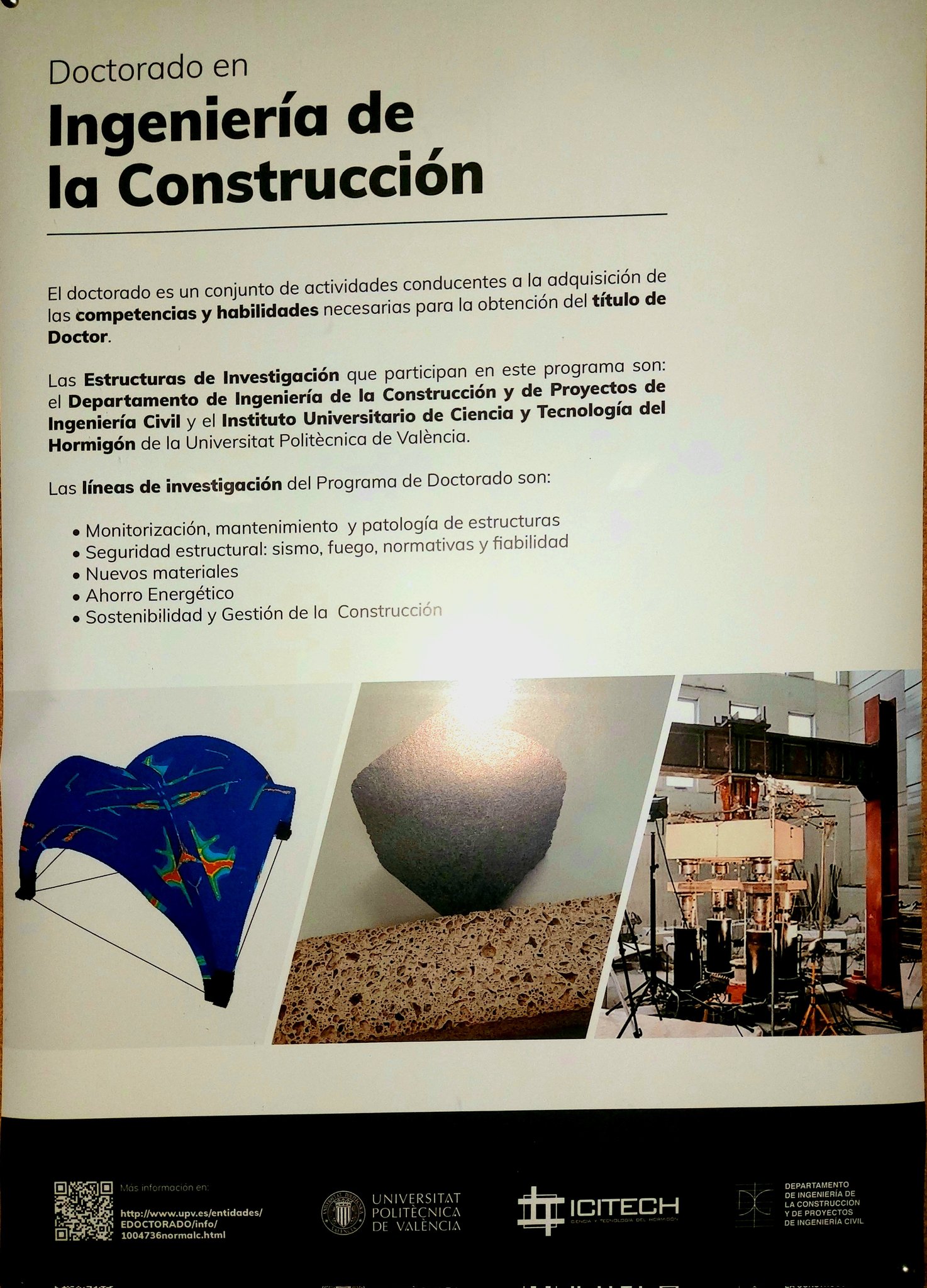
¿Quieres incorporarte a nuestro grupo de investigación con un contrato predoctoral?

Quien quiera trabajar con nuestro grupo de investigación tiene una oportunidad de contrato predoctoral FPU. Será bienvenido. Acaba de salir: https://www.boe.es/diario_boe/txt.php?id=BOE-B-2021-46596

En este momento estamos iniciando un proyecto de investigación que se llama HYDELIFE, del cual te puedes informar en los siguientes enlaces:
Si además, quieres ver qué tipo de publicaciones hacemos en nuestro grupo, te remito al siguiente enlace:
Creemos que es una muy buena oportunidad de incorporarte a nuestro grupo de investigación. Te esperamos.


Proyecto de referencia:
  • Optimización híbrida del ciclo de vida de puentes y estructuras mixtas y modulares de alta eficiencia social y medioambiental bajo presupuestos restrictivos. (HYDELIFE). [Hybrid life cycle optimization of bridges and mixed and modular structures with high social and environmental efficiency under restrictive budgets]. PID2020-117056RB-I00.

Special Issue «2nd Edition of Trends in Sustainable Buildings and Infrastructure»

High visibility: indexed by the Science Citation Index Expanded, the Social Sciences Citation Index (Web of Science) and other databases. Impact Factor: 3.390 (2020)

JCR category rank: Q1: Public, Environmental & Occupational Health (SSCI) | Q2: Public, Environmental & Occupational Health (SCIE) | Q2: Environmental Sciences (SCIE)

Special Issue “2nd Edition of Trends in Sustainable Buildings and Infrastructure”

A special issue of International Journal of Environmental Research and Public Health (ISSN 1660-4601).

Deadline for manuscript submissions: 30 September 2022.

Special Issue Editors

Guest Editor

Prof. Dr. Víctor Yepes
Concrete Science and Technology Institute (ICITECH), Department of Construction Engineering and Civil Engineering Projects, Universitat Politècnica de València Valencia, Spain
Interests: multiobjective optimization; structures optimization; lifecycle assessment; social sustainability of infrastructures; reliability-based maintenance optimization; optimization and decision-making under uncertainty

Guest Editor

Prof. Dr. Moacir Kripka
Civil and Environmental Engineering Graduate Program (PPGEng), University of Passo Fundo, Passo Fundo CEP 99052-900, Brazil
Interests: structural analysis; optimization; building; engineering optimization; civil engineering; linear programming; mathematical programming; heuristics; structural optimization; concrete; combinatorial optimization; structural engineering; multiobjective optimization; reinforced concrete; optimization methods; discrete optimization; optimization theory; simulated annealing; optimization software

Special Issue Information

Dear Colleagues,

This Special Issue is the 2nd edition of Trends in Sustainable Buildings and Infrastructure. The recently established Sustainable Development Goals call for a paradigm shift in the way buildings and infrastructures are conceived. The construction industry is a main source of environmental impacts, given its great material consumption and energy demands. It is also a major contributor to the economic growth of regions through the provision of useful infrastructure and generation of employment, among others. Conventional approaches underlying current building design practices fall short of covering the relevant environmental and social implications derived from inappropriate design, construction, and planning. The development of adequate sustainable design strategies is therefore becoming extremely relevant with regard to the achievement of the United Nations 2030 Agenda Goals for Sustainable Development.

This Special Issue aims to increase knowledge on sustainable design practices by highlighting the actual research trends that explore efficient ways to reduce the environmental consequences related to the construction industry while promoting social wellbeing and economic development. These objectives include but are not limited to:

  • Life-cycle-oriented building and infrastructure design;
  • Design optimization based on sustainable criteria;
  • Maintenance design towards sustainability;
  • Inclusion of social impacts in the design of buildings and infrastructures;
  • Resilience and sustainability;
  • Use of sustainable materials;
  • Decision-making processes that effectively integrate economic, environmental, and social aspects.

Papers selected for this Special Issue will be subject to a rigorous peer-review procedure with the aim of rapid and wide dissemination of research results, developments, and applications.

Submission

Manuscripts should be submitted online at www.mdpi.com by registering and logging in to this website. Once you are registered, click here to go to the submission form. Manuscripts can be submitted until the deadline. All papers will be peer-reviewed. Accepted papers will be published continuously in the journal (as soon as accepted) and will be listed together on the special issue website. Research articles, review articles as well as short communications are invited. For planned papers, a title and short abstract (about 100 words) can be sent to the Editorial Office for announcement on this website.

Submitted manuscripts should not have been published previously, nor be under consideration for publication elsewhere (except conference proceedings papers). All manuscripts are thoroughly refereed through a single-blind peer-review process. A guide for authors and other relevant information for submission of manuscripts is available on the Instructions for Authors page. International Journal of Environmental Research and Public Health is an international peer-reviewed open access semimonthly journal published by MDPI.

Keywords

  • Sustainable design and construction
  • Life cycle assessment
  • Sustainability in decision making
  • Green buildings
  • Sustainable maintenance
  • Resilient structures
  • Sustainable materials
  • Social life cycle assessment
  • Sustainable management of infrastructures
  • Multiobjective optimization for sustainable development

Oferta contrato predoctoral para Proyecto de Investigación HYDELIFE

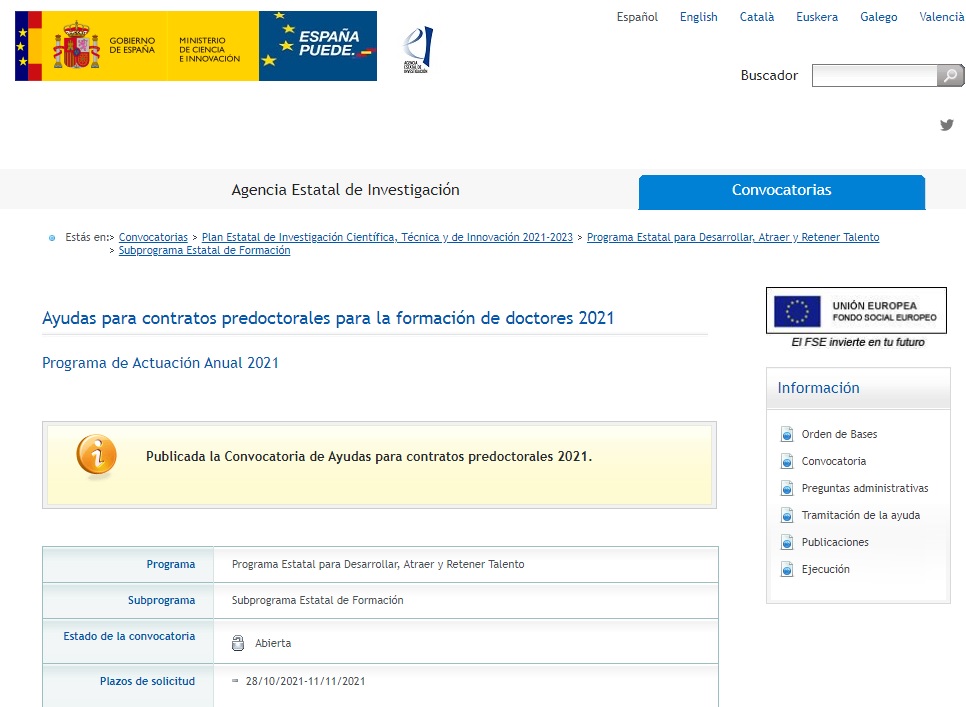
En el BOE del 17 de octubre, la Presidencia de la Agencia Estatal de Investigación ha publicado el anuncio de la convocatoria de  2021 de ayudas para contratos predoctorales para la formación de doctores asociadas a proyectos de investigación. Los proyectos de la Universitat Politècnica de València susceptibles de asignación de ayuda están disponibles en la web del Ministerio de  Ciencia, Innovación y Universidades, en el siguiente enlace: proyectos.

Como ya sabéis, se nos adjudicó recientemente el Proyecto de Investigación HYDELIFE, del cual soy Investigador Principal: Optimización híbrida del ciclo de vida de puentes y estructuras mixtas y modulares de alta eficiencia social y medioambiental bajo presupuestos restrictivos (PID2020-117056RB-I00). Este proyecto tiene asignado un contrato predoctoral (antiguas becas FPI), cuya convocatoria ya está en marcha.

Quien esté interesado en este contrato, puede solicitarlo hasta el 11 de noviembre de 2021, a las 14:00 horas (hora peninsular española).

Es una muy buena oportunidad para realizar, mediante un contrato, la tesis doctoral. Asimismo, también hay opción a pedir un contrato de formación de profesor universitario (antiguas becas FPU) para también estar en disposición de realizar la tesis.

Te podrás incorporar a nuestro equipo de investigación y colaborar en las líneas de trabajo que tenemos en marcha dentro del ICITECH (Instituto de Ciencia y Tecnología del Hormigón).

Requisitos para las personas solicitantes:

Podrán ser solicitantes todas aquellas personas que estén matriculadas o admitidas en un programa de doctorado para el curso 2021/2022, en el momento de presentación de la solicitud. También podrán ser solicitantes todas aquellas personas que, en el momento de presentación de la solicitud, no estando matriculadas o admitidas en un programa de doctorado, estén en disposición de estarlo en la fecha en la que se formalice el contrato.

Cada solicitante únicamente podrá presentar una solicitud y cada solicitud vendrá referida a un proyecto de investigación.

No podrán ser solicitantes, ni acceder a la contratación que se incentiva, quienes cumplan cualquiera de las siguientes circunstancias:

  • Haber disfrutado de un contrato predoctoral por tiempo superior a doce meses, previamente a la presentación de la solicitud.
  • Estar en posesión del título de Doctor, por cualquier universidad española o extranjera.
  • Haber iniciado su formación predoctoral con financiación de otras ayudas destinadas a la formación predoctoral a través del desarrollo de una tesis doctoral que se hayan otorgado en el marco del Plan Estatal de Investigación.

Toda la información la puedes consultar en el siguiente enlace:

http://www.aei.gob.es/portal/site/MICINN/menuitem.dbc68b34d11ccbd5d52ffeb801432ea0/?vgnextoid=4c6c68d98570c710VgnVCM1000001d04140aRCRD


Siempre han existido grandes inventos

En la clase de «Gestión de la innovación en el sector de la construcción«, del Máster Universitario en Gestión y Planificación en Ingeniería Civil, muchas veces se debate sobre los inventos. Si éstos se deben a mentes brillantes, a la casualidad o a un proceso planificado de innovación en las empresas. Incluso si los inventos o la innovación deben originarse en la investigación y el desarrollo tecnológico. Pero incluso en épocas anteriores al desarrollo del método científico, ya se inventaban cosas.

Os paso un documental donde se muestra cómo los grandes inventos a veces son muy antiguos: la pila eléctrica de Bagdad, las máquinas griegas para hacer cálculos astronómicos, la máquina de vapor de Herón de Alejandría, las técnicas de construcción de las pirámides de Gizeh y del Machu Picchu Inca, o los conocimientos de neurocirugía y de aviación de los indios Nazca, inventos todos ellos que permanecieron ocultos miles de años y que hubieran podido cambiar el destino de la humanidad.

High Performance and Optimum Structures and Materials Encompassing Shock and Impact Loading HPSM/OPTI/SUSI 2022

This scientific event is a new edition of the High Performance and Optimum Design of Structures and Materials Conference and follows that originated in Southampton as long ago as 1989 and the Structures under Shock and Impact that started in Cambridge, Massachusetts, also in 1989.

The use of novel materials and new structural concepts nowadays is not restricted to highly technical areas like aerospace, aeronautical applications or the automotive industry, but affects all engineering fields including those such as civil engineering and architecture. The conference addresses issues involving advanced types of structures, particularly those based on new concepts. Contributions will highlight the latest development in design and manufacturing issues.

Most high-performance structures require the development of a generation of new materials, which can more easily resist a range of external stimuli or react in a non-conventional manner. Particular emphasis will be placed on intelligent structures and materials as well as the application of computational methods for their modelling, control and management.

The conference also addresses the topic of design optimisation. Contributions on numerical methods and different optimisation techniques are also welcome, as well as papers on new software. Optimisation problems of interest to the meeting involve those related to size, shape and topology of structures and materials. Optimisation techniques have much to offer to those involved in the design of new industrial products, as the appearance of powerful commercial computer codes has created a fertile field for the incorporation of optimisation in the design process in all engineering disciplines.

The performance of the structures under shock and impact loads is another objective of the meeting. The increasing need to protect civilian infrastructure and industrial facilities against unintentional loads arising from accidental impact and explosion events as well as terrorist attacks is reflected in the sustained interest worldwide. While advances have been made in the last decades, many challenges remain, such as developing more effective and efficient blast and impact mitigation approaches than those that currently exist or assessing the uncertainties associated with large and small scale testing and validation of numerical and analytical models. All of that aimed to a better understanding of critical issues relating to the testing behaviour, modelling and analyses of protective structures against blast and impact loading.

The meeting will provide a friendly and useful forum for the interchange of ideas and interaction amongst researchers, designers and scholars in the community to share advances in the scientific fields related to the conference topics.

All conference papers are archived in the Wessex Institute eLibrary (www.witpress.com/elibrary) where they are easily and permanently available in Open Access format to the international community.

Conference Topics

The following list covers some of the topics to be presented at HPSM/OPTI/SUSI 2022. Papers on other subjects related to the objectives of the conference are also welcome.

  • Composite materials
  • Material characterisation
  • Natural fibre composites
  • Nanocomposites
  • Green composites
  • Composites for automotive applications
  • Transformable structures
  • Environmentally friendly and sustainable structures
  • Reliability-based design optimisation
  • Non-deterministic approaches
  • Evolutionary methods in optimisation
  • Aerospace structures
  • Biomechanics application
  • Lightweight structures
  • Design for sustainability
  • Design for durability
  • Lifecycle assessment
  • Structural reliability
  • Smart materials and structures
  • Optimization of civil engineering structures
  • Optimization in mechanical engineering
  • Optimization in the car industry
  • Design optimization of tall buildings
  • Metaheuristic algorithms
  • New algorithms for size and topology optimisation
  • BIM tools for design optimization
  • Emerging materials
  • Impact and blast loading
  • Energy-absorbing issues
  • Computational and experimental results
  • Response of reinforced concrete under impact
  • Seismic behaviour
  • Protection of existing structures
  • Industrial accidents and explosions
  • Security issues
  • Response of composite structures to blast and impact
  • Vehicle impact
  • Ballistics analysis
  • Dynamic material behaviour
  • Fluid-structure interaction
  • Seismic soil-structure interaction
  • Case studies

More information: https://www.wessex.ac.uk/conferences/2022/hpsm-opti-susi-2022

Pincha aquí para descargar


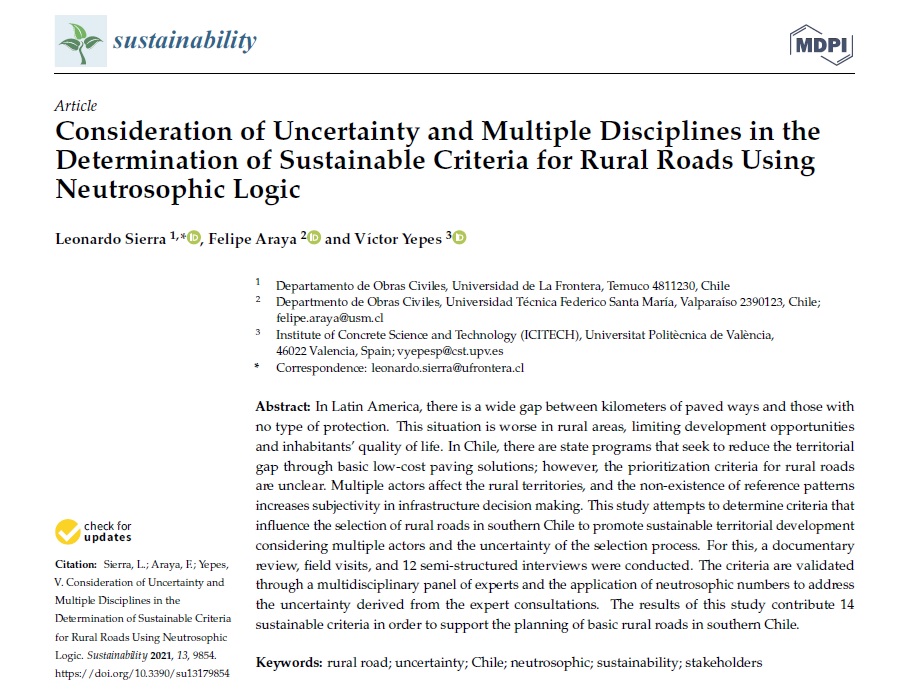
Sostenibilidad de las carreteras rurales mediante la lógica neutrosófica

Acaban de publicarnos un artículo en la revista Sustainability, revista indexada en el JCR. En este caso se ha considerado la incertidumbre en la determinación de los criterios para la sostenibilidad en carreteras rurales usando la lógica neutrosófica. El trabajo se enmarca dentro del proyecto de investigación HYDELIFE que dirijo como investigador principal en la Universitat Politècnica de València.

En Latinoamérica existe una gran diferencia entre los kilómetros de vías pavimentadas y los que no tienen ningún tipo de protección. Esta situación se agrava en las zonas rurales, limitando las oportunidades de desarrollo y la calidad de vida de los habitantes. En Chile, existen programas estatales que buscan reducir la brecha territorial a través de soluciones básicas de pavimentación de bajo costo; sin embargo, los criterios de priorización aplicables a los caminos rurales son poco claros. Son múltiples los actores que intervienen en los espacios rurales, y la inexistencia de patrones de referencia aumenta la subjetividad en la toma de decisiones de este tipo de infraestructuras. Este estudio intenta determinar los criterios que influyen en la selección de caminos rurales en el sur de Chile para promover el desarrollo territorial sostenible considerando los múltiples actores y la incertidumbre del proceso de selección. Para ello, se realizó una revisión documental, visitas a terreno y 12 entrevistas semiestructuradas. Los criterios se han validado a través de un panel multidisciplinario de expertos y la aplicación de números neutrosóficos para abordar la incertidumbre derivada de estas consultas. Los resultados de este estudio aportan 14 criterios basados en la sostenibilidad para apoyar la planificación de caminos rurales básicos en el sur de Chile.

Abstract:

In Latin America, there is a wide gap between kilometers of paved ways and those with no type of protection. This situation is worse in rural areas, limiting development opportunities and inhabitants’ quality of life. In Chile, there are state programs that seek to reduce the territorial gap through basic low-cost paving solutions; however, the prioritization criteria for rural roads are unclear. Multiple actors affect the rural territories, and the non-existence of reference patterns increases subjectivity in infrastructure decision making. This study attempts to determine criteria that influence the selection of rural roads in southern Chile to promote sustainable territorial development considering multiple actors and the uncertainty of the selection process. For this, a documentary review, field visits, and 12 semi-structured interviews were conducted. The criteria are validated through a multidisciplinary panel of experts and the application of neutrosophic numbers to address the uncertainty derived from the expert consultations. The results of this study contribute 14 sustainable criteria in order to support the planning of basic rural roads in southern Chile.

Keywords:

Rural road; uncertainty; Chile; neutrosophic; sustainability; stakeholders

Reference:

SIERRA, L.; ARAYA, F.; YEPES, V. (2021). Consideration of uncertainty and multiple disciplines in the determination of sustainable criteria for rural roads using neutrosophic logic. Sustainability, 13(17):9854. DOI:10.3390/su13179854

Pincha aquí para descargar

Open Access Book: Trends in Sustainable Buildings and Infrastructure

Tengo el placer de compartir con todos vosotros, totalmente en abierto, un libro que he editado junto con Ignacio J. Navarro. La labor de editar libros científicos es una oportunidad de poder seleccionar aquellos autores y temas que destacan en un ámbito determinado. En este caso, sobre las tendencias en las infraestructuras y la construcción sostenible.

Además, resulta gratificante ver que el libro se encuentra editado en abierto, por lo que cualquiera de vosotros os lo podéis descargar sin ningún tipo de problema en esta entrada del blog. También os lo podéis descargar, o incluso pedirlo en papel, en la página web de la editorial MPDI: https://www.mdpi.com/books/pdfview/book/3854

Referencia:

YEPES, V.; NAVARRO, I.J. (Eds.) (2021). Trends in Sustainable Buildings and Infrastructure. MPDI, 272 pp., Basel, Switzerland. ISBN: 978-3-0365-0914-3


Preface to ”Trends in Sustainable Buildings and Infrastructure”

The Sustainable Development Goals agreed by the United Nations in 2015 advocate for a profound paradigm shift in the way that infrastructures are designed. Actual practices usually fall short in assessing issues beyond the economic ones. Aspects such as the environmental impacts resulting from the life cycle of our structures, as well as the positive and negative effects that their construction and maintenance can have on society, are new criteria that need to be effectively included in our designs by 2030. To face such a challenging task, actual practices need to be reinvented, approaching the design of infrastructures from a holistic perspective that simultaneously integrates each of the three dimensions of sustainability, namely economy, environment and society. This book comprises 11 chapters that explore the actual sustainability-related trends in the construction sector. The chapters collect the papers included in the Special Issue “Trends in Sustainable Buildings and Infrastructure” of the International Journal of Environmental Research and Public Health. We would like to thank both the MDPI publishing and editorial staff for their excellent work, as well as the authors who have collaborated in its preparation. The papers included in this book cover a broad range of topics directly related to the sustainable design of infrastructures, addressing maintenance design criteria towards sustainability, life-cycle-oriented building and infrastructure design, design optimization based on sustainable criteria, inclusion of the social dimension in the design of infrastructures and the application of decision-making processes that effectively integrate the three dimensions of sustainability, resilience and the use of sustainable materials.

About the Editors

Víctor Yepes is a full professor of Construction Engineering; he holds a Ph.D. in civil engineering. He serves at the Department of Construction Engineering, Universitat Politècnica de València, Valencia, Spain. He has been the Academic Director of the M.S. studies in concrete materials and structures since 2007 and a Member of the Concrete Science and Technology Institute (ICITECH). He is currently involved in several projects related to the optimization and life-cycle assessment of concrete structures, as well as optimization models for infrastructure asset management. He currently teaches courses in construction methods, innovation, and quality management. He has authored more than 250 journals and conference papers, including more than 100 published in journals quoted in JCR. He acted as an expert for project proposal evaluation for the Spanish Ministry of Technology and Science, and he is a main researcher in many projects. He currently serves as an Editor-in-Chief for the International Journal of Construction Engineering and Management and a member of the editorial board of 12 other international journals (Structure and Infrastructure Engineering, Structural Engineering and Mechanics, Mathematics, Sustainability, Revista de la Construcci´on, Advances in Civil Engineering, Advances in Concrete Construction, among others).

Ignacio Navarro Martíınez holds a Ph.D. degree in civil engineering. He works at the Department of Construction Engineering, Universitat Politècnica de València, Valencia, Spain. He has published 11 articles and 9 conference papers in JCR journal. He combines his research activity with his professional career as a structural designer. During his professional experience, he has been dedicated to the calculation of steel and concrete structures related to renewable energies, especially in the field of wind energy, both onshore and offshore, as well as to the calculation of road and port structures. He has specialized in the numerical calculation of steel and concrete structures in onshore and offshore environments.

Pincha aquí para descargar

Análisis de ciclo de vida de aislamientos reciclados en edificación para diferentes condiciones climáticas en España

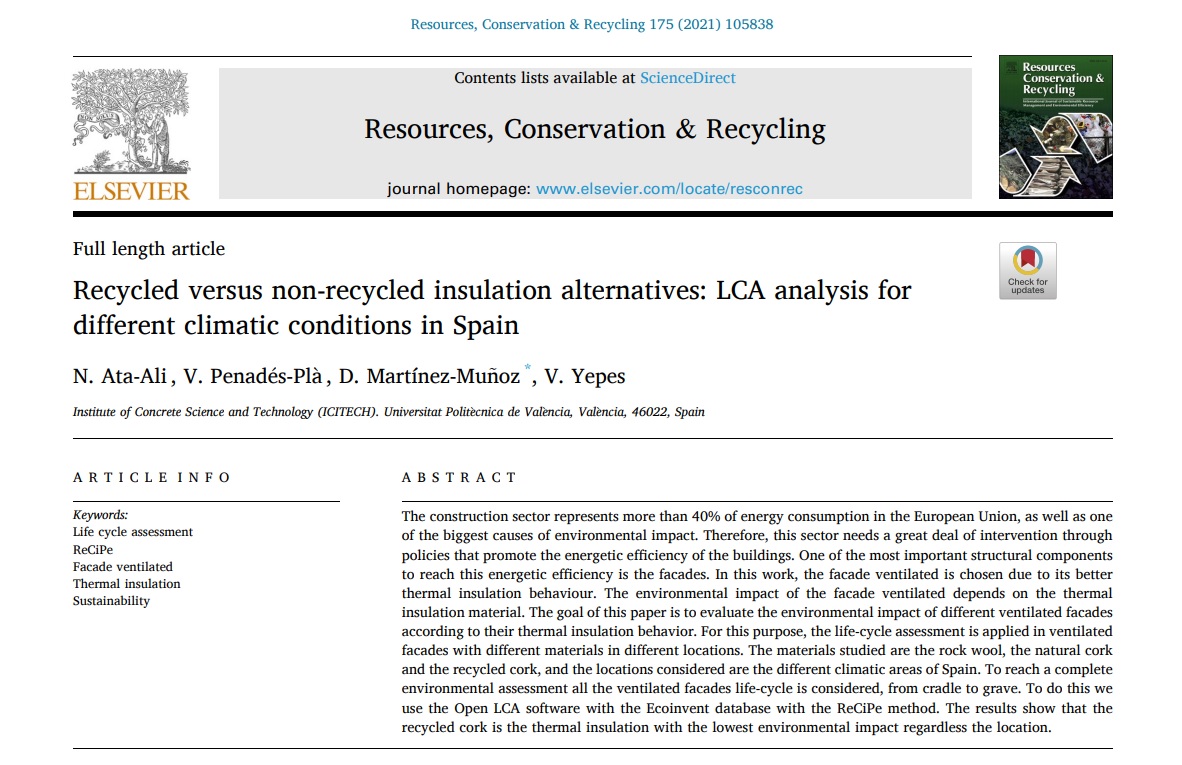
Acaban de publicarnos un artículo en la revista Resources, Conservation and Recycling, revista de alto impacto indexada en el JCR. En este caso se ha realizado un análisis del ciclo de vida de los aislamientos utilizados en edificación reciclados y no reciclados, atendiendo a las diferentes condiciones climáticas de España. El trabajo se enmarca dentro del proyecto de investigación HYDELIFE que dirijo como investigador principal en la Universitat Politècnica de València.

El sector de la construcción representa más del 40% del consumo de energía en la Unión Europea, así como una de las causas significativas de impacto ambiental. Por ello, este sector necesita políticas que promuevan la eficiencia energética de los edificios. Uno de los componentes estructurales más importantes para alcanzar esta eficiencia energética son las fachadas. En este trabajo se elige la fachada ventilada por su mejor comportamiento de aislamiento térmico. El impacto ambiental de la fachada ventilada depende del material de aislamiento térmico. El objetivo de este trabajo es evaluar el impacto ambiental de diferentes fachadas ventiladas en función de su comportamiento de aislamiento térmico. Para ello, se aplica la evaluación del ciclo de vida en fachadas ventiladas con diferentes materiales en distintas ubicaciones. Los materiales estudiados son la lana de roca, el corcho natural y el corcho reciclado, y las ubicaciones consideradas son las diferentes zonas climáticas de España. Para llegar a una evaluación ambiental completa se considera todo el ciclo de vida de las fachadas ventiladas, desde la cuna hasta la tumba. Para ello se utiliza el software Open LCA con la base de datos Ecoinvent con el método ReCiPe. Los resultados muestran que el corcho reciclado es el aislamiento térmico con menor impacto ambiental, independientemente de la ubicación.

Abstract:

The construction sector represents more than 40% of energy consumption in the European Union, as well as one of the biggest causes of environmental impact. Therefore, this sector needs a great deal of intervention through policies that promote the energetic efficiency of the buildings. One of the most important structural components to reach this energetic efficiency is the facades. In this work, the facade ventilated is chosen due to its better thermal insulation behaviour. The environmental impact of the facade ventilated depends on the thermal insulation material. The goal of this paper is to evaluate the environmental impact of different ventilated facades according to their thermal insulation behavior. For this purpose, the life-cycle assessment is applied in ventilated facades with different materials in different locations. The materials studied are the rock wool, the natural cork and the recycled cork, and the locations considered are the different climatic areas of Spain. To reach a complete environmental assessment all the ventilated facades life-cycle is considered, from cradle to grave. To do this we use the Open LCA software with the Ecoinvent database with the ReCiPe method. The results show that the recycled cork is the thermal insulation with the lowest environmental impact regardless the location.

Keywords:

Life cycle assessment; ReCiPe; Facade ventilated; Thermal insulation; Sustainability

Reference:

ATA-ALI, N.; PENADÉS-PLÀ, V.; MARTÍNEZ-MUÑOZ, D.; YEPES, V. (2021). Recycled versus non-recycled insulation alternatives LCA analysis for different climatic conditions in Spain. Resources, Conservation and Recycling, 175, 105838. DOI:10.1016/j.resconrec.2021.105838

Pincha aquí para descargar

Métodos de decisión para definir la mejor producción en la industria de la maquinaria agrícola

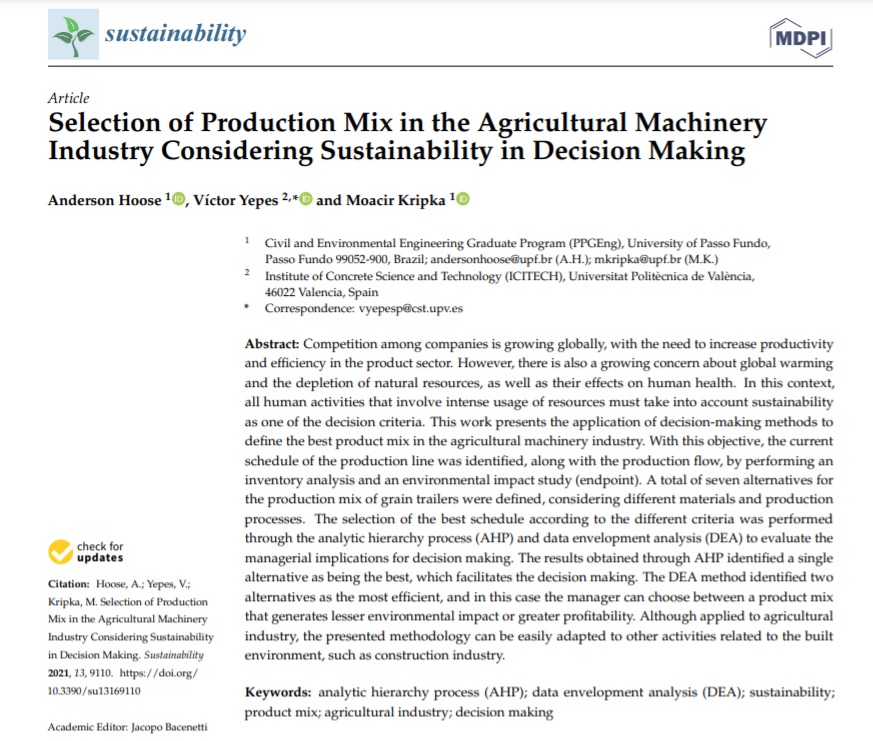
Acaban de publicarnos un artículo en la revista Sustainability, revista indexada en el JCR. En este caso se ha realizado un análisis comparativo de la producción de la maquinaria agrícola considerando la sostenibilidad en la toma de decisión multicriterio. El trabajo se enmarca dentro del proyecto de investigación HYDELIFE que dirijo como investigador principal en la Universitat Politècnica de València.

Este trabajo presenta la aplicación de métodos de decisión para definir la mejor producción en la industria de la maquinaria agrícola. Con este objetivo, se identificó la programación actual de la línea de producción, así como el flujo de producción, realizando un análisis de inventario y un estudio de impacto ambiental. Se definieron siete alternativas para el mix de producción de remolques de grano, considerando diferentes materiales y procesos de producción. La selección de la mejor programación según los diferentes criterios se realizó mediante el proceso de jerarquía analítica (AHP) y el análisis envolvente de datos (DEA) para evaluar las implicaciones gerenciales en la toma de decisiones. Los resultados obtenidos mediante el AHP identificaron una única alternativa como la mejor, lo que facilita la toma de decisiones. El método DEA identificó dos alternativas como las más eficientes, y en este caso el gestor puede elegir entre una combinación de productos que genere un menor impacto ambiental o una mayor rentabilidad. Aunque se aplica a la industria agrícola, la metodología presentada puede adaptarse fácilmente a otras actividades relacionadas con el entorno construido, como la industria de la construcción.

Abstract:

Competition among companies is growing globally, with the need to increase productivity and efficiency in the product sector. However, there is also a growing concern about global warming and the depletion of natural resources, as well as their effects on human health. In this context, all human activities that involve intense usage of resources must take into account sustainability as one of the decision criteria. This work presents the application of decision-making methods to define the best product mix in the agricultural machinery industry. With this objective, the current schedule of the production line was identified, along with the production flow, by performing an inventory analysis and an environmental impact study (endpoint). A total of seven alternatives for the production mix of grain trailers were defined, considering different materials and production processes. The selection of the best schedule according to the different criteria was performed through the analytic hierarchy process (AHP) and data envelopment analysis (DEA) to evaluate the managerial implications for decision making. The results obtained through AHP identified a single alternative as being the best, which facilitates the decision making. The DEA method identified two alternatives as the most efficient, and in this case the manager can choose between a product mix that generates lesser environmental impact or greater profitability. Although applied to agricultural industry, the presented methodology can be easily adapted to other activities related to the built environment, such as construction industry.

Keywords:

Analytic hierarchy process (AHP); data envelopment analysis (DEA); sustainability; product mix; agricultural industry; decision making

Reference:

HOOSE, A.; YEPES, V.; KRIPKA, M. (2021). Selection of Production Mix in the Agricultural Machinery Industry considering Sustainability in Decision Making. Sustainability, 13(16), 9110; DOI:10.3390/su13169110

Pincha aquí para descargar

Hacia un mapa de conocimiento algorítmico de optimización de la industria AEC-AI (Arquitectura, Ingeniería, Construcción e Inteligencia Artificial)

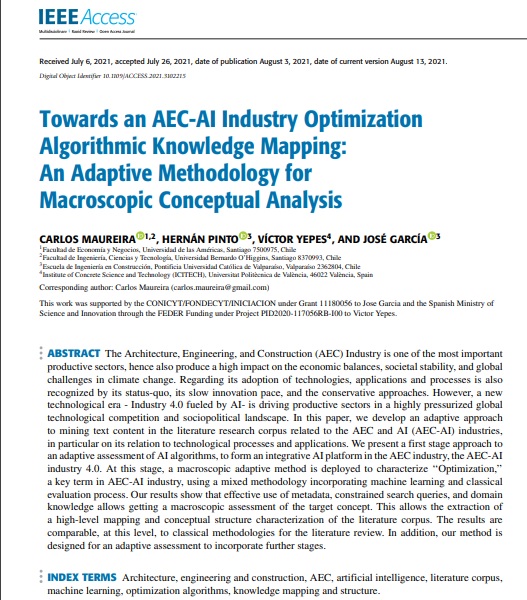
Acaban de publicarnos un artículo en la revista IEEE Access, revista de alto impacto indexada en el JCR. En este caso se ha realizado un análisis conceptual macroscópico de la industria AEC-AI (Arquitectura, Ingeniería, Construcción e Inteligencia Artificial). El trabajo se enmarca dentro del proyecto de investigación HYDELIFE que dirijo como investigador principal en la Universitat Politècnica de València.

La industria de la arquitectura, la ingeniería y la construcción (AEC) constituye uno de los sectores productivos más relevantes, por lo que también produce un alto impacto en los equilibrios económicos, la estabilidad de la sociedad y los desafíos globales en el cambio climático. En cuanto a su adopción de tecnologías, aplicaciones y procesos también se reconoce por su status-quo, su lento ritmo de innovación, y los enfoques conservadores. Sin embargo, una nueva era tecnológica -la Industria 4.0 alimentada por la IA- está impulsando los sectores productivos en un panorama sociopolítico y de competencia tecnológica global altamente presionado. En este trabajo, desarrollamos un enfoque adaptativo para la minería de contenido textual en el corpus de investigación de la literatura relacionada con las industrias de la AEC y la IA (AEC-AI), en particular en su relación con los procesos y aplicaciones tecnológicas. Presentamos un enfoque de primera etapa para una evaluación adaptativa de los algoritmos de IA, para formar una plataforma integradora de IA en la industria AEC, la industria AEC-AI 4.0. En esta etapa, se despliega un método adaptativo macroscópico para caracterizar la «Optimización», un término clave en la industria AEC-AI, utilizando una metodología mixta que incorpora el aprendizaje automático y el proceso de evaluación clásico. Nuestros resultados muestran que el uso eficaz de los metadatos, las consultas de búsqueda restringidas y el conocimiento del dominio permiten obtener una evaluación macroscópica del concepto objetivo. Esto permite la extracción de un mapeo de alto nivel y la caracterización de la estructura conceptual del corpus bibliográfico. Los resultados son comparables, a este nivel, a las metodologías clásicas de revisión de la literatura. Además, nuestro método está diseñado para una evaluación adaptativa que permita incorporar otras etapas.

Abstract:

The Architecture, Engineering, and Construction (AEC) Industry is one of the most important productive sectors, hence also produce a high impact on the economic balances, societal stability, and global challenges in climate change. Regarding its adoption of technologies, applications and processes is also recognized by its status-quo, its slow innovation pace, and the conservative approaches. However, a new technological era – Industry 4.0 fueled by AI- is driving productive sectors in a highly pressurized global technological competition and sociopolitical landscape. In this paper, we develop an adaptive approach to mining text content in the literature research corpus related to the AEC and AI (AEC-AI) industries, in particular on its relation to technological processes and applications. We present a first stage approach to an adaptive assessment of AI algorithms, to form an integrative AI platform in the AEC industry, the AEC-AI industry 4.0. At this stage, a macroscopic adaptive method is deployed to characterize “Optimization,” a key term in AEC-AI industry, using a mixed methodology incorporating machine learning and classical evaluation process. Our results show that effective use of metadata, constrained search queries, and domain knowledge allows getting a macroscopic assessment of the target concept. This allows the extraction of a high-level mapping and conceptual structure characterization of the literature corpus. The results are comparable, at this level, to classical methodologies for the literature review. In addition, our method is designed for an adaptive assessment to incorporate further stages.

Keywords:

Architecture, engineering and construction, AEC, artificial intelligence, literature corpus, machine learning, optimization algorithms, knowledge mapping and structure

Reference:

MAUREIRA, C.; PINTO, H.; YEPES, V.; GARCÍA, J. (2021). Towards an AEC-AI industry optimization algorithmic knowledge mapping. IEEE Access, 9:110842-110879. DOI:10.1109/ACCESS.2021.3102215

Pincha aquí para descargar