A continuación os dejo un artículo donde se aplica la optimización heurística mediante recocido simulado de ménsulas cortas de hormigón armado, usando para ello elementos finitos con fisuración distribuida.
ROJAS, G.; ROJAS, P.; GONZÁLEZ-VIDOSA, F.; YEPES, V. (2012). Heuristic optimization of short corbels by smeared cracking finite element analysis. International Conference on Computer Aided Optimum Design in Engineering, 20-22 june. Computer Aided Optimum Design in Engineering XII. Vol. 125, pp. 71-82. Edited By: S. HERNANDEZ, University of A Coruña, Spain, C.A. BREBBIA, Wessex Institute of Technology, UK and W.P. DE WILDE, Vrije Universiteit Brussel, Belgium. DOI: 10.2495/OP120071 ISSN: 1743-3509 (on line).
Es más, ¿es posible que un ordenador diseñe de forma automática estructuras óptimas sin darle ninguna pista ni información previa? Estoy convencido de que a la vuelta de un par de años, todos los programas comerciales tendrán paquetes de optimización estructural que permitirán reducciones de coste del 5 al 15% respecto a los programas actuales. Ya os adelanto que esta nueva tecnología va a traer consigo nuevas patologías en las estructuras de hormigón, que, con la optimización, se parecen más a las estructuras metálicas. Con el tiempo habrá que introducir capítulos o restricciones en las futuras versiones de la EHE o de los Eurocódigos. En este post continuamos comentando aspectos relacionados con la modelización matemática, la optimización combinatoria, las metaheurísticas y los algoritmos.
Toda esta aventura la empezamos en el año 2002, con el primer curso de doctorado sobre optimización heurística en la ingeniería civil, que luego hemos ido ampliando y mejorando en el actual Máster Oficial en Ingeniería del Hormigón. Ya tenemos varias tesis doctorales y artículos científicos al respecto para quienes de vosotros estén curiosos o interesados en el tema. Para aquellos que queráis ver algunas aplicaciones concretas, os recomiendo el siguiente capítulo del libro que escribimos sobre la optimización de distintas estructuras mediante un algoritmo tan simple como la cristalización simulada. Para quienes tengan más curiosidad, os dejo algunas publicaciones de nuestro grupo de investigación en el apartado de referencias.
Os paso, para abrir la boca, una forma sencilla de optimizar a través de este Polimedia. Espero que os guste.
Referencias:
MOLINA-MORENO, F.; MARTÍ, J.V.; YEPES, V. (2017). Carbon embodied optimization for buttressed earth-retaining walls: implications for low-carbon conceptual designs.Journal of Cleaner Production, 164:872-884. https://authors.elsevier.com/a/1VLOP3QCo9NDzg
GARCÍA-SEGURA, T.; YEPES, V.; FRANGOPOL, D.M. (2017). Multi-Objective Design of Post-Tensioned Concrete Road Bridges Using Artificial Neural Networks.Structural and Multidisciplinary Optimization, 56(1):139-150. doi: 10.1007/s00158-017-1653-0
YEPES, V.; MARTÍ, J.V.; GARCÍA-SEGURA, T.; GONZÁLEZ-VIDOSA, F. (2017). Heuristics in optimal detailed design of precast road bridges.Archives of Civil and Mechanical Engineering, 17(4):738-749. DOI: 10.1016/j.acme.2017.02.006
MOLINA-MORENO, F.; GARCÍA-SEGURA; MARTÍ, J.V.; YEPES, V. (2017). Optimization of Buttressed Earth-Retaining Walls using Hybrid Harmony Search Algorithms.Engineering Structures, 134:205-216. DOI: 10.1016/j.engstruct.2016.12.042
GARCÍA-SEGURA, T.; YEPES, V. (2016). Multiobjective optimization of post-tensioned concrete box-girder road bridges considering cost, CO2 emissions, and safety.Engineering Structures, 125:325-336. DOI: 10.1016/j.engstruct.2016.07.012.
MARTÍ, J.V.; GARCÍA-SEGURA, T.; YEPES, V. (2016). Structural design of precast-prestressed concrete U-beam road bridges based on embodied energy.Journal of Cleaner Production, 120:231-240. DOI: 10.1016/j.jclepro.2016.02.024
GARCÍA-SEGURA, T.; YEPES, V.; ALCALÁ, J.; PÉREZ-LÓPEZ, E. (2015). Hybrid harmony search for sustainable design of post-tensioned concrete box-girder pedestrian bridges.Engineering Structures, 92:112-122. DOI: 10.1016/j.engstruct.2015.03.015 (link)
LUZ, A.; YEPES, V.; GONZÁLEZ-VIDOSA, F.; MARTÍ, J.V. (2015). Diseño de estribos abiertos en puentes de carretera obtenidos mediante optimización híbrida de escalada estocástica.Informes de la Construcción, 67(540), e114. DOI: 10.3989/ic.14.089
MARTÍ, J.V.; YEPES, V.; GONZÁLEZ-VIDOSA, F. (2015). Memetic algorithm approach to designing of precast-prestressed concrete road bridges with steel fiber-reinforcement.Journal of Structural Engineering ASCE, 141(2): 04014114. DOI:10.1061/(ASCE)ST.1943-541X.0001058(descargar versión autor)
YEPES, V.; GARCÍA-SEGURA, T.; MORENO-JIMÉNEZ, J.M. (2015). A cognitive approach for the multi-objective optimization of RC structural problems.Archives of Civil and Mechanical Engineering, 15(4):1024-1036. doi:10.1016/j.acme.2015.05.001
YEPES, V.; MARTÍ, J.V.; GARCÍA-SEGURA, T. (2015). Cost and CO2 emission optimization of precast-prestressed concrete U-beam road bridges by a hybrid glowworm swarm algorithm.Automation in Construction, 49:123-134. DOI: 10.1016/j.autcon.2014.10.013 (link)
GARCÍA-SEGURA, T.; YEPES, V.; MARTÍ, J.V.; ALCALÁ, J. (2014). Optimization of concrete I-beams using a new hybrid glowworm swarm algorithm. Latin American Journal of Solids and Structures, 11(7):1190 – 1205. ISSN: 1679-7817. (link)
MARTÍ, J.V.; YEPES, V.; GONZÁLEZ-VIDOSA, F.; LUZ, A. (2013). Diseño automático de tableros óptimos de puentes de carretera de vigas artesa prefabricadas mediante algoritmos meméticos híbridos.Revista Internacional de Métodos Numéricos para Cálculo y Diseño en Ingeniería, DOI: http://dx.doi.org/10.1016/j.rimni.2013.04.010.
TORRES-MACHÍ, C.; YEPES, V.; ALCALA, J.; PELLICER, E. (2013). Optimization of high-performance concrete structures by variable neighborhood search.International Journal of Civil Engineering, 11(2):90-99 . ISSN: 1735-0522. (link)
MARTÍNEZ-MARTÍN, F.; GONZÁLEZ-VIDOSA, F.; HOSPITALER, A.; YEPES, V. (2013). A parametric study of optimum tall piers for railway bridge viaducts.Structural Engineering and Mechanics, 45(6): 723-740. (link)
MARTINEZ-MARTIN, F.J.; GONZALEZ-VIDOSA, F.; HOSPITALER, A.; YEPES, V. (2012). Multi-objective optimization design of bridge piers with hybrid heuristic algorithms.Journal of Zhejiang University-SCIENCE A (Applied Physics & Engineering, 13(6):420-432. DOI: 10.1631/jzus.A1100304. ISSN 1673-565X (Print); ISSN 1862-1775 (Online). (link)
MARTÍ, J.V.; GONZÁLEZ-VIDOSA, F.; YEPES, V.; ALCALÁ, J. (2013). Design of prestressed concrete precast road bridges with hybrid simulated annealing.Engineering Structures, 48:342-352. DOI:10.1016/j.engstruct.2012.09.014. ISSN: 0141-0296.(link)
YEPES, V.; GONZÁLEZ-VIDOSA, F.; ALCALÁ, J.; VILLALBA, P. (2012). CO2-Optimization Design of Reinforced Concrete Retaining Walls based on a VNS-Threshold Acceptance Strategy.Journal of Computing in Civil Engineering ASCE, 26 (3):378-386. DOI: 10.1061/(ASCE)CP.1943-5487.0000140. ISNN: 0887-3801. (link)
CARBONELL, A.; YEPES, V.; GONZÁLEZ-VIDOSA, F. (2011). Búsqueda exhaustiva por entornos aplicada al diseño económico de bóvedas de hormigón armado. Revista Internacional de Métodos Numéricos para Cálculo y Diseño en Ingeniería, 27(3):227-235. (link) [Global best local search applied to the economic design of reinforced concrete vauls]
CARBONELL, A.; GONZÁLEZ-VIDOSA, F.; YEPES, V. (2011). Heuristic optimization of reinforced concrete road vault underpasses.Advances in Engineering Software, 42(4): 151-159. ISSN: 0965-9978. (link)
MARTÍNEZ, F.J.; GONZÁLEZ-VIDOSA, F.; HOSPITALER, A. (2011). Estudio paramétrico de pilas para viaductos de carretera.Revista Internacional de Métodos Numéricos para Cálculo y Diseño en Ingeniería, 27(3):236-250. (link)
MARTÍNEZ, F.J.; GONZÁLEZ-VIDOSA, F.; HOSPITALER, A.; ALCALÁ, J. (2011). Design of tall bridge piers by ant colony optimization.Engineering Structures, 33:2320-2329.
PEREA, C.; YEPES, V.; ALCALÁ, J.; HOSPITALER, A.; GONZÁLEZ-VIDOSA, F. (2010). A parametric study of optimum road frame bridges by threshold acceptance.Indian Journal of Engineering & Materials Sciences, 17(6):427-437. ISSN: 0971-4588. (link)
PAYÁ-ZAFORTEZA, I.; YEPES, V.; GONZÁLEZ-VIDOSA, F.; HOSPITALER, A. (2010). On the Weibull cost estimation of building frames designed by simulated annealing.Meccanica, 45(5): 693-704. DOI 10.1007/s11012-010-9285-0. ISSN: 0025-6455. (link)
MARTÍ, J.V.; GONZÁLEZ-VIDOSA, F. (2010). Design of prestressed concrete precast pedestrian bridges by heuristic optimization.Advances in Engineering Software, 41(7-8): 916-922. http://dx.doi.org/10.1016/j.advengsoft.2010.05.003
MARTÍNEZ, F.J.; GONZÁLEZ-VIDOSA, F.; HOSPITALER, A.; YEPES, V. (2010). Heuristic Optimization of RC Bridge Piers with Rectangular Hollow Sections.Computers & Structures, 88: 375-386. ISSN: 0045-7949. (link)
PAYÁ, I.; YEPES, V.; HOSPITALER, A.; GONZÁLEZ-VIDOSA, F. (2009). CO2-EfficientDesign of Reinforced Concrete Building Frames.Engineering Structures, 31: 1501-1508. ISSN: 0141-0296. (link)
YEPES, V.; ALCALÁ, J.; PEREA, C.; GONZÁLEZ-VIDOSA, F. (2008). A Parametric Study of Optimum Earth Retaining Walls by Simulated Annealing. Engineering Structures, 30(3): 821-830. ISSN: 0141-0296. (link)
PEREA, C.; ALCALÁ, J.; YEPES, V.; GONZÁLEZ-VIDOSA, F.; HOSPITALER, A. (2008). Design of Reinforced Concrete Bridge Frames by Heuristic Optimization.Advances in Engineering Software, 39(8): 676-688. ISSN: 0965-9978. (link)
PAYÁ, I.; YEPES, V.; GONZÁLEZ-VIDOSA, F.; HOSPITALER, A. (2008). Multiobjective Optimization of Reinforced Concrete Building Frames by Simulated Annealing.Computer-Aided Civil and Infrastructure Engineering, 23(8): 596-610. ISSN: 1093-9687. (link)
PAYÁ, I.; YEPES, V.; CLEMENTE, J.J.; GONZÁLEZ-VIDOSA, F. (2006). Optimización heurística de pórticos de edificación de hormigón armado.Revista Internacional de Métodos Numéricos para Cálculo y Diseño en Ingeniería, 22(3): 241-259. [Heuristic optimization of reinforced concrete building frames]. (link)
ABSTRACT: The sustainability approach has changed the modern society. Currently, the sustainability takes into consideration, not only the economic and environmental facets, but also the social facet. Taking into account the three facets of sustainability, this paper shows the application of a method of active learning to assess the sustainability of three real retaining walls. A group of 29 students of the Master of Science in Planning and Management in Civil Engineering at the Universitat Politècnica de València has experienced this assessment. The method followed was proposed by academics of the School of Civil Engineering of the Universitat Politècnica de València (Spain) and Universidad de La Frontera (Chile). An approach multi-criteria and a clusters analysis are part of method, which allows developing a participative process with different points of view about the sustainability. The outcomes show that of this way students can forecast impacts from of the integration of design, planning and the location context of the infrastructure. Result evidence that personal values of each student influences the election of the optimal alternative. The paper also identifies the need to strengthen the conceptualization of social criteria in the students training.
SIERRA-VARELA, L.; YEPES, V.; PELLICER, E. (2017). Sustainable assessment of retaining walls through an active learning method considering multiple stakeholders. Proceedings of the Ninth International Structural Engineering and Construction Conference, Valencia, Spain, July 24-July 29. doi: 10.14455/ISEC.res.2017.51
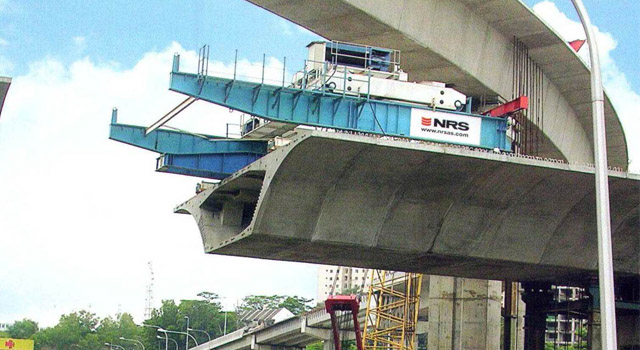
Viga de lanzamiento de dovelas. Fuente: http://www.tecsa.com.mx/
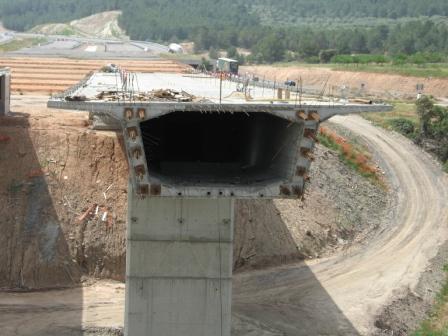
La luz máxima económica para puentes construidos con dovelas prefabricadas es de unos 150 m. Por encima de 120 m, el coste de los dispositivos de colocación, en particular la viga de lanzamiento, aumenta rápidamente, al igual que el peso de las dovelas. En cuanto a luces mínimas, se han construido pasos superiores a 18 m con este sistema. Además, la prefabricación se ve favorecida por el número de obras idénticas que deben construirse. Otro factor a tener en cuenta es la superficie total del tablero. Así, y dependiendo de la disponibilidad de los medios auxiliares de la empresa, se necesitaría un mínimo de 5000 m² de tablero para considerar la utilización de dovelas prefabricadas mediante grúas, cerchas o puentes-grúa, e incluso con equipos móviles que se desplacen por el tablero. En cambio, es necesario un mínimo de 10000 m² de tablero para colocar las dovelas prefabricadas mediante una viga de lanzamiento.
En cuanto a las tendencias actuales en este tipo de puentes, podemos citar las siguientes:
Supresión de la cola en las juntas: Su eliminación presenta ventajas, no solo por el coste de la cola, sino por reducir el tiempo de ensamblaje al permitir la unión en una sola operación de todas las dovelas de un vano. Sin embargo, su supresión implica renunciar al efecto rubricante y exige una mayor precisión en el ensamblaje de las dovelas para evitar fisurar las llaves al concentrar los esfuerzos en ellas. La cola permite el reparto de cargas y la eliminación de los puntos duros causados por rebabas, retracciones diferenciales u otros defectos. Además, las recientes investigaciones muestran que la resistencia a la rotura de las uniones con junta seca es inferior a la de juntas con cola.
Elementos prefabricados como encofrados: En paramentos con formas complejas o para acabados de gran calidad, a veces se utilizan paneles prefabricados montados sobre cimbrado para su uso como encofrado perdido. Sin embargo, esta solución es más cara.
Prefabricación parcial: En obras de tamaño medio, muchas veces no se puede amortizar la instalación de prefabricación de las dovelas, por lo que se recurre a prefabricar únicamente las almas y dejar para un hormigonado “in situ” las losas superior e inferior. Los puentes de Brotonne y de Clichy se construyeron con almas prefabricadas. Ello permite reducir la potencia de los medios de montaje, así como dar continuidad a las armaduras pasivas de la losa inferior y, en buena parte, de la superior.
Pretensado exterior: Permite eliminar las operaciones de montaje y replanteo de vainas, disminuye las anchuras de las almas y reduce las pérdidas por rozamiento, lo que mejora la eficiencia del pretensado.
Nos acaban de publicar en la revista de Elsevier del primer decil, Journal of Cleaner Production, un artículo en el que se estudia el diseño de muros de contrafuertes optimizados para reducir sus emisiones de CO2. Este artículo forma parte de nuestra línea de investigación BRIDLIFE, en la que se pretende optimizar las estructuras atendiendo no solo a su coste, sino también al impacto ambiental que generan a lo largo de su ciclo de vida.
Abstract:
This paper shows the differences in the design of a reinforced concrete structure when two objectives are considered: minimizing economic cost and CO2 emissions. Both objectives depend on the amount of two high-carbon-intensive materials: cement in the concrete and steel; therefore, these objectives are related. As the balance between steel and cement per m3 of concrete depends on several factors, such as the type of structure, this study focuses on buttressed earth-retaining walls. Another factor that determines the balance between steel and concrete is the wall’s height. Thus, the methodology employs a parametric study of optimal designs for buttressed earth-retaining walls, with the wall height as one parameter. One objective is to show the variation in cost when CO2 is minimized while respecting economic constraints. The findings show that wall elements under bending-compressive strains (i.e., the buttressed retaining wall stem) behave differently depending on the target function. On the one hand, the study reveals an upward trend in steel per unit volume of concrete in emission-optimized earth-retaining buttressed walls compared to cost-optimized ones. On the other hand, it is observed that, unlike cost-optimized walls, emission-optimized walls use a higher concrete class than the minimum available. These findings indicate that emission-optimized walls penalize not only concrete volume but also cement content, to the extent that a higher concrete class outperforms in terms of reduced emissions. Additionally, the paper outlines how and to what extent the design of this typology varies across the two analyzed objectives in terms of geometry and material quantity. Some relevant differences influencing the geometry of design strategies are found.
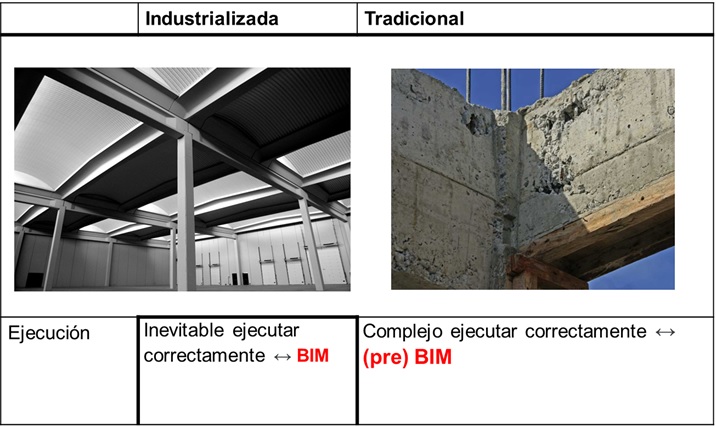
Resumen: En un contexto social y reglamentario cada vez más exigente, coexisten tres tendencias que se presentan como una inmejorable oportunidad para la consolidación definitiva de las soluciones prefabricadas de hormigón como la variante industrializada de la construcción de edificios e infraestructuras, con todas las ventajas que ello proporciona en términos de rapidez de ejecución, control más exhaustivo en proyecto y obra, calidad, precisión dimensional, eficiencia y rentabilidad económica. Tanto BIM, como las declaraciones ambientales de producto y la inercia térmica, son tres aspectos que guardan una correlación.
LÓPEZ-VIDAL, A.; YEPES, V. (2017). BIM, declaraciones ambientales de producto e inercia térmica: tres vías para la consolidación de las soluciones en prefabricado de hormigón. VII Congreso de ACHE, A Coruña, junio de 2017, 9 pp.
Abstract: Structural engineers focus on the reduction of carbon emissions in reinforced concrete structures, while other impacts affecting ecosystems and human health become secondary or are left behind. The featured life cycle assessment shows the impacts corresponding to each construction stage of an earth-retaining wall with buttresses. In this study the contribution ratio of each input flow is analyzed. Accordingly, concrete, landfill, machinery, formwork, steel, and transport are considered. Results show that despite the concrete almost always accounts for the largest contribution to each impact, the impact shares of steel present noticeable sensitivity to the steel-manufacturing route. The parameter of study is the recycling rate, usually 75% reached in Spain. Noticeable variation is found when the recycling content increases. The relationship between the impacts of each material with the amount of material used discloses research interest.
Keywords: Life cycle assessment, Functional unit, Steel recycling rate, Concrete ratio, Photochemical oxidation, Ozone depletion, Global warming.
Reference:
MOLINA-MORENO, F.; MARTÍ, J.V.; YEPES, V.; CIROTH, A. (2017). Environmental impact shares of a reinforced concrete earth-retaining wall with buttresses.The Ninth International Structural Engineering and Construction Conference, Resilient Structures and Sustainable Construction ISEC-9, Valencia, Spain July 24-July 29.
En un contexto social y reglamentario cada vez más exigente, coexisten tres tendencias que se presentan como una inmejorable oportunidad para la consolidación definitiva de las soluciones prefabricadas de hormigón como la variante industrializada de la construcción de edificios e infraestructuras, con todas las ventajas que ello proporciona en términos de rapidez de ejecución, control más exhaustivo en proyecto y obra, calidad, precisión dimensional, eficiencia y rentabilidad económica. Tanto BIM, como las declaraciones ambientales de producto y la inercia térmica, son tres aspectos que guardan una correlación.
Referencia:
López-Vidal, A.; Yepes, V. (2017). BIM, declaraciones ambientales de producto e inercia térmica: tres vías para la consolidación de las soluciones en prefabricado de hormigón. VII Congreso de ACHE, A Coruña, junio de 2017, 9 pp.
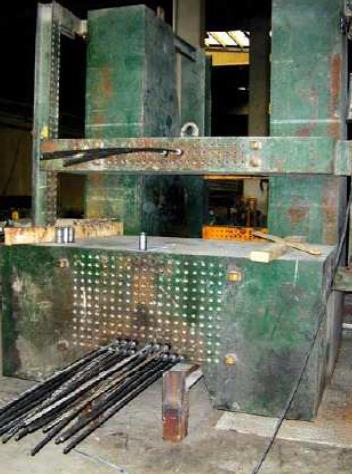
Vista del extremo de la bancada de tesado. Cortesía: ANDECE.
Los elementos de hormigón pretensado son productos habituales de las plantas de prefabricados. Para realizar el tesado de las armaduras activas, se utilizan bancadas de tesado. Estos elementos permiten anclar los cables en los extremos de la pista, donde se encuentra una solera de hormigón que servirá de base para el molde. Estas bancadas suelen ser largas, de 100 a 150 m, pues a mayor distancia entre los elementos de anclaje, mayor economía, siempre y cuando no se contrarreste el momento flector al que se le somete.
Las bancadas son estructuras metálicas fabricadas con chapas de resistencia suficiente para soportar la tracción de las armaduras. Además, presentan cimentaciones muy grandes, capaces de soportar las fuerzas de pretensado que se apliquen. En otras ocasiones, el propio molde presenta los elementos de anclaje en sus extremos, y la bancada sirve como fondo de molde. En este caso, el molde es autorresistente y puede trasladarse a otro lugar de la planta.
Extremo de la bancada de tesado. Cortesía: ANDECE.
Se pueden fabricar distintos tipos de piezas en una misma bancada, siempre que no se exceda el límite de la fuerza de pretensado que la bancada puede soportar. La cantidad de cables colocados determinará la magnitud de la fuerza de pretensado aplicada.
Para comprobar que la relación fuerza de pretensado/altura de actuación de los cables se mantiene dentro de los márgenes de seguridad exigibles, las bancadas disponen de una placa visible con un gráfico donde se establecerán los valores máximos. A mayor altura de la resultante de la acción de los cables, menor será la fuerza total admisible.
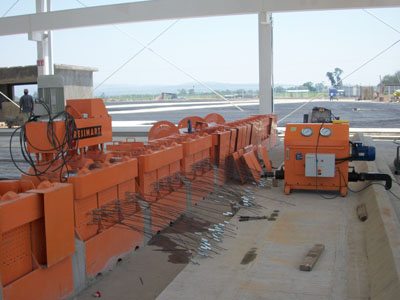
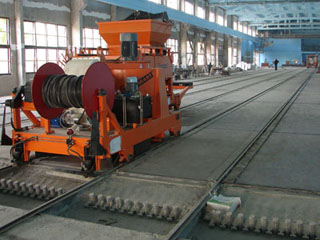
Extendedora del cable de pretensado en la bancada. Fuente: www.resimart.com
Los moldes se comercializan y las bancadas se dimensionan para una fuerza máxima nominal determinada. Esto se corresponde con la fuerza y la excentricidad de los cables del canto máximo que se pueda fabricar. Si la excentricidad es menor, podría aplicarse una fuerza de pretensado superior a la nominal.
A continuación, os dejo algunos vídeos en los que podemos ver cómo son algunas instalaciones de prefabricados. En este primer vídeo podemos ver cómo se fabrican las viguetas pretensadas Tensyland (Prensoland).
Aquí vemos el mismo proceso de fabricación de viguetas, en este caso, de la empresa VELOSA.
En este otro vídeo también vemos el proceso de fabricación de viguetas de hormigón pretensado.
Civil Engineers are involved with the creation, monitoring, and management of infrastructural resources, as well as the ecient, economic utilization and management of renewable natural resources. Nowadays a rapid growth of computer performance enables and encourages new developments in civil engineering as well as related areas. For instance, the construction industry investigates new designs with minimum cost, minimum CO2 emissions, or embodied energy, among other objectives. Conventional optimization techniques are usually inadequate to nd best designs by taking into account all design variables, objectives, and constraints in the complex civil engineering problems. Applications of optimization techniques are most exciting, challenging, and of truly large scale when it comes to the problems of civil engineering in terms of both quality and quantity. In order to overcome the diculties, researchers are interested in advanced optimization techniques. In the recent literature, researchers have applied the advanced optimization techniques to dierent purposes.
The aim of this special issue is to collect the studies using optimization algorithms in civil engineering problems such as structural engineering, construction management, and environmental engineering. Potential topics include but are not limited to the following: Intelligent optimization Swarm and evolutionary optimization techniques Single and multiobjective optimization Predictive modeling and optimization Computational complexity and optimization Continuous or discrete optimization Structural optimization Size, shape, and topology optimization New design optimization applications in civil engineering New and novel approaches and techniques for solving optimization problems in civil engineering New research in any areas closely related to optimization and civil engineering designs Authors can submit their manuscripts through the Manuscript Tracking System at http://mts.hindawi.com/submit/journals/ace/otace/


 A continuación os dejo un artículo donde se aplica la optimización heurística mediante recocido simulado de ménsulas cortas de hormigón armado, usando para ello elementos finitos con fisuración distribuida.