
 Acaban de publicarnos un artículo en la revista Journal of Civil Engineering and Management, indexada en Q2 del JCR. Se trata de una revisión del estado del arte sobre la toma de decisiones multicriterio en el análisis sostenible del ciclo de vida de los puentes.
El trabajo se enmarca en el proyecto de investigación DIMALIFE, que dirijo como investigador principal en la Universitat Politècnica de València.
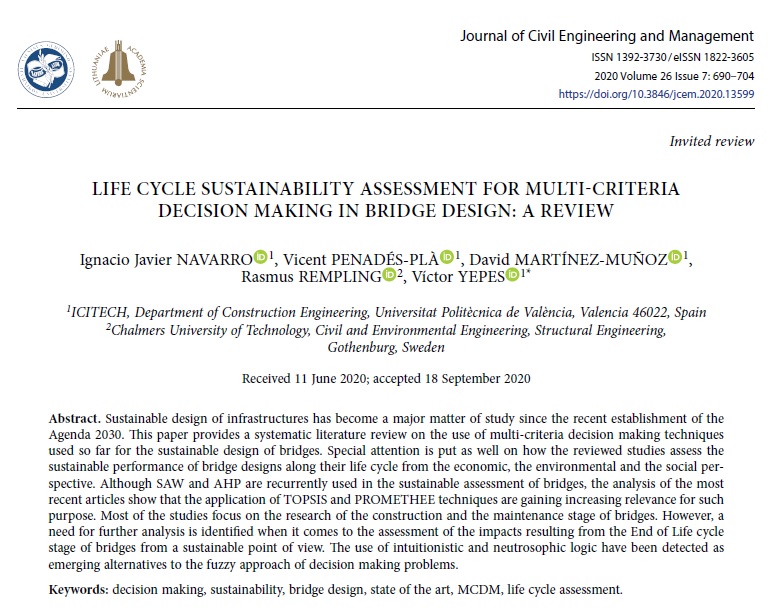
El diseño sostenible de las infraestructuras se ha convertido en un tema de estudio importante desde el reciente establecimiento de la Agenda 2030. En este artículo se ofrece una revisión sistemática de la bibliografía sobre el uso de técnicas de toma de decisiones basadas en criterios múltiples aplicadas hasta ahora al proyecto sostenible de puentes. También se presta especial atención a la forma en que los estudios evalúan el comportamiento sostenible de los diseños de los puentes a lo largo de su ciclo de vida desde las perspectivas económicas, ambientales y sociales. Aunque SAW y AHP se utilizan de manera recurrente en la evaluación sostenible de los puentes, el análisis de los artículos más recientes muestra que la aplicación de las técnicas TOPSIS y PROMETHEE está cobrando cada vez más relevancia para tal fin. La mayoría de los estudios se centran en la investigación sobre la construcción y la etapa de mantenimiento de los puentes. Sin embargo, se identifica la necesidad de un análisis más profundo cuando se trata de evaluar los impactos resultantes de la etapa del fin del ciclo vital de los puentes desde un punto de vista sostenible. Se ha detectado el uso de la lógica intuitiva y neutrosófica como alternativas emergentes al enfoque difuso de los problemas de toma de decisiones.
ABSTRACT
Sustainable infrastructure design has become a major area of study since the recent establishment of the Agenda 2030. This paper provides a systematic literature review of the use of multi-criteria decision-making techniques for the sustainable design of bridges. Special attention is also given to how the reviewed studies assess the sustainable performance of bridge designs throughout their life cycles from economic, environmental, and social perspectives. Although SAW and AHP are frequently used in the sustainable assessment of bridges, the analysis of recent articles shows that the application of TOPSIS and PROMETHEE techniques is gaining increasing relevance for this purpose. Most studies focus on the construction and maintenance stages of bridges. However, a need for further analysis is identified in assessing the impacts of bridges’ end-of-life cycle stage from a sustainable perspective. The use of intuitionistic and neutrosophic logic has been detected as an emerging alternative to the fuzzy approach of decision-making problems.
KEYWORDS:
Decision-making, sustainability, bridge design, state-of-the-art, MCDM, life-cycle assessment.
REFERENCE:
NAVARRO, I.J.; PENADÉS-PLÀ, V.; MARTÍNEZ-MUÑOZ, D.; REMPLING, R.; YEPES, V. (2020). Life cycle sustainability assessment for multi-criteria decision making in bridge design: A review. Journal of Civil Engineering and Management, 26(7):690-704. DOI:10.3846/jcem.2020.13598