

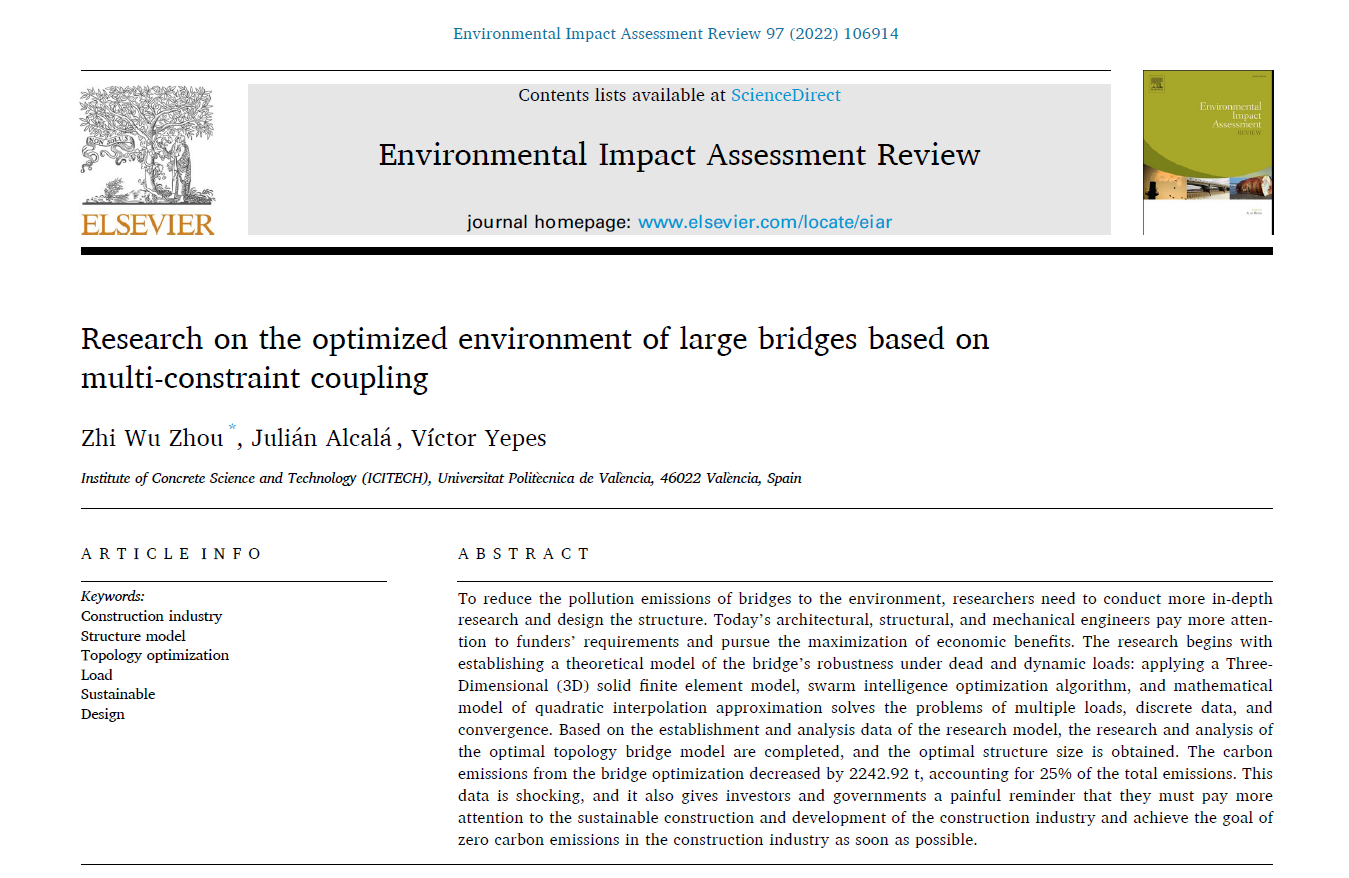
Nos acaban de publicar en la revista Environmental Impact Assessment Review (primer cuartil del JCR) un artículo sobre la optimización ambiental de grandes puentes mediante el acoplamiento de múltiples restricciones. El trabajo se enmarca en el proyecto de investigación HYDELIFE, que dirijo como investigador principal en la Universitat Politècnica de València.
Para minimizar el impacto ambiental de los puentes, es fundamental explorar su diseño con mayor profundidad. Los ingenieros actualmente suelen priorizar los aspectos financieros y buscan maximizar los beneficios económicos. Por esta razón, este estudio comienza por establecer un modelo teórico de la robustez del puente ante cargas estáticas y dinámicas. Para lograr esto, se aplica un modelo de elementos finitos en tres dimensiones, un algoritmo de optimización basado en inteligencia de enjambre y un modelo matemático de aproximación por interpolación cuadrática. Tras analizar el modelo de puente con una topología óptima, se determina el tamaño ideal de la estructura. Como resultado, las emisiones de carbono se redujeron en 2.242,92 toneladas, lo que equivale al 25% de las emisiones totales. Estos resultados son significativos y deben ser un recordatorio para inversores y gobiernos de la importancia de fomentar la construcción y el desarrollo sostenible de la industria. Es necesario avanzar hacia el objetivo de cero emisiones de carbono en la industria de la construcción lo antes posible.
Abstract:
To reduce the environmental pollution from bridges, researchers need to conduct more in-depth research and design the structures. Today’s architectural, structural, and mechanical engineers pay more attention to funders’ requirements and pursue the maximization of economic benefits. The research begins with establishing a theoretical model of the bridge’s robustness under dead and dynamic loads: applying a Three-Dimensional (3D) solid finite element model, swarm intelligence optimization algorithm, and mathematical model of quadratic interpolation approximation solves the problems of multiple loads, discrete data, and convergence. Based on the establishment and analysis of the research model, the optimal topology bridge model is analysed, and the optimal structural size is obtained. The carbon emissions from the bridge optimization decreased by 2242.92 t, accounting for 25% of the total emissions. This data is shocking and also gives investors and governments a painful reminder that they must pay closer attention to the sustainable development of the construction industry and achieve the goal of zero carbon emissions in the industry as soon as possible.
Keywords:
Construction industry; Structure model; Topology optimization; Load; Sustainable; Design
Reference:
ZHOU, Z.; ALCALÁ, J.; YEPES, V. (2022). Research on the optimized environment of large bridges based on multi-constraint coupling. Environmental Impact Assessment Review, 97:106914. DOI:10.1016/j.eiar.2022.106914